MCQ
Two projectiles are thrown simultaneously in the same plane from the same point. If their velocities are $v_1$ and $v_2$ at angles $\theta _1$ and $\theta_2$ respectively from the horizontal, then answer the following question

The trajectory of particle $1$ with respect to particle $2$ will be

  • A
    a parabola
  • a straight line
  • C
    a vertical straight line
  • D
    a horizontal straight line

Answer

Correct option: B.
a straight line
b
$V_{12(x)}=v_{1} \cos \theta_{1}-v_{2} \cos \theta_{2}$

$a_{12(x)}=0 \Rightarrow V_{12(y)}-V_{1} \sin _{1}^{\theta}-V_{2} \sin ^{\theta}_{2}$

$\Rightarrow a_{12(y)}=0$

$x=v_{12(x)} t \ldots(1)$

$y=v_{12(y)} t \ldots(2)$

From $(1) \&(2) Y=\frac{V_{12}(y)}{V_{12(y)}}$

Need a full question paper?

Generate a complete, print-ready paper with questions like this in minutes — across 16+ boards, with answer keys.

Start Generating Free

Similar questions

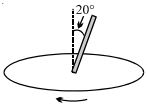
$A$ uniform rod is fixed to a rotating turntable so that its lower end is on the axis of the turntable and it makes an angle of $20^o$ to the vertical. (The rod is thus rotating with uniform angular velocity about a vertical axis passing through one end.) If the turntable is rotating clockwise as seen from above. Is there a torque acting on it, and if so in what direction?
A student of mass $M$ is $1.5 \,m$ tall and has her centre of mass $1 \,m$ above ground when standing straight. She wants to jump up vertically. To do so. she bends her knees so that her centre of mass is lowered by $0.2 \,m$ and then pushes the ground by a constant force F. As a result, she jumps up such that the maximum height of her feet is $0.3 \,m$ above ground. The ratio $F / Mg$ is
A particle of mass $m_1$​ moving with a velocity of $5\ m/ s$ collides head on with a stationary particle of mass $m_2$​. After collision both the particle move with a common velocity of $4\ m/ s,$ then the value $m_1 / m_2\ Z$ is:
The height $y$ and the distance $x$ along the horizontal plane of a projectile on a certain planet (with no surrounding atmosphere) are given by $y = (8t - 5{t^2})$ meter and $x = 6t\, meter$, where $t$ is in second., the acceleration due to gravity is given by ......... $m/{\sec ^2}$
A $7\ kg$ object is subjected to two forces $($in Newton$) \vec{\text{F}}_1=20\hat{\text{i}}+30\hat{\text{j}}$ and $\vec{\text{F}}_2=8\hat{\text{i}}-5\hat{\text{j}}$ The magnitude of resulting acceleration in $ms^{-2}$ will be:
In an experiment of determine the Young's modulus of wire of a length exactly $1\; m$, the extension in the length of the wire is measured as $0.4\,mm$ with an uncertainty of $\pm 0.02\,mm$ when a load of $1\,kg$ is applied. The diameter of the wire is measured as $0.4\,mm$ with an uncertainty of $\pm 0.01\,mm$. The error in the measurement of Young's modulus $(\Delta Y)$ is found to be $x \times 10^{10}\,Nm ^{-2}$. The value of $x$ is

$\left[\right.$ Take $\left.g =10\,m / s ^{2}\right]$

A cricket ball is thrown by a player at a speed of $20\,m / s$ in a direction $30^{\circ}$ above the horizontal. The maximum height attained by the ball during its motion is $........\,m$ $\left( g =10\,m / s ^2\right)$
Which of the following is not a thermodynamics co-ordinate
Choose the incorrect statement from the following
When a body is placed on a rough plane inclined at an angle $\theta $ to the horizontal, its acceleration is