MCQ
The working of optical instruments like camera, microscope, telescope, etc. having glass lenses is based on a phenomenon of light. Identify the phenomenon.
  • Reflection
  • B
    Refraction
  • C
    Dispersion
  • D
    Scattering

Answer

Correct option: A.
Reflection

Need a full question paper?

Generate a complete, print-ready paper with questions like this in minutes — across 16+ boards, with answer keys.
Start Generating Free

Similar questions

Consider a thin spherical shell of radius $R$ with its centre at the origin, carrying uniform positive surface charge density. The variation of the magnitude of the electric field $|\vec{E}(r)|$ and the electric potential $V(r)$ with the distance r from the centre, is best represented by which graph?
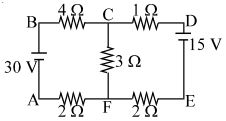
The figure shows a network of five resistances and two batteries The current through the $15\,V$ battery is .............. $A$
In a transistor configuration $\beta$-parameter is
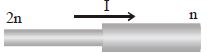
Two cylindrical rods of uniform crosssection area $A$ and $2A$, having free electrons per unit volume $2n$ and $n$ respectively are joined in series. A current $I$ flows through them in steady state. Then the ratio of drift velocity of free electron in left rod to drift velocity of electron in the right rod is $\left( {\frac{{{v_L}}}{{{v_R}}}} \right)$
The oscillating electric and magnetic vectors of an electromagnetic wave are oriented along:
The ratio of the forces between two small spheres with constant charge $(a)$ in air $(b)$ in a medium of dielectric constant $K$ is
When cathode rays (tube voltage $~ 10 kV$) collide with the anode of high atomic weight then we get
Compare the dispersive powers of two prisms if one of them deviates the blue and red rays through $10^{\circ}$ and $6^{\circ}$ respectively and the second prism through $8^{\circ}$ and $4.5^{\circ}$
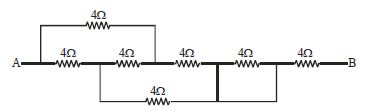
Equivalent resistance between $A$ and $B$ is ............ $\Omega$
The 21 cm radio wave emitted by hydrogen in interstellar space is due to the interaction called the hyperfine interaction is atomic hydrogen. the energy of the emitted wave is nearly