The Young's modulus of a rubber string $8\, cm$ long and density $1.5\,kg/{m^3}$ is $5 \times {10^8}\,N/{m^2}$, is suspended on the ceiling in a room. The increase in length due to its own weight will be
AIIMS 1986, Medium
Download our app for free and get started
(b)$l = \frac{{{L^2}dg}}{{2Y}} = \frac{{{{(8 \times {{10}^{ - 2}})}^2} \times 1.5 \times 9.8}}{{2 \times 5 \times {{10}^8}}}$
$ = 9.6 \times {10^{ - 11}}m$

Download our appand get started for free
Experience the future of education. Simply download our apps or reach out to us for more information. Let's shape the future of learning together!No signup needed.*
Similar Questions
- 1If the compressibility of water is $\sigma $ per unit atmospheric pressure, then the decrease in volume $V$ due to $P$ atmospheric pressure will beView Solution
- 2View SolutionWhich of the following statements is correct
- 3When a certain weight is suspended from a long uniform wire, its length increases by one $cm$. If the same weight is suspended from another wire of the same material and length but having a diameter half of the first one, the increase in length will be ......... $cm$View Solution
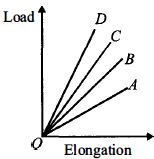
- 4View SolutionThe load versus elongation graphs for four wires of same length and made of the same material are shown in the figure. The thinnest wire is represented by the line
- 5A bar is subjected to axial forces as shown. If $E$ is the modulus of elasticity of the bar and $A$ is its crosssection area. Its elongation will beView Solution

- 6View SolutionAccording to Hook’s law of elasticity, if stress is increased, the ratio of stress to strain
- 7When a block of mass $M$ is suspended by a long wire of length $L$, the length of the wire become $(L+l) .$ The elastic potential energy stoped in the extended wire is :View Solution
- 8A compressive force, $F$ is applied at the two ends of a long thin steel rod. It is heated, simultaneously, such that its temperature increases by $\Delta T$. The net change in its length is zero. Let $l$ be the length of the rod, $A$ its area of cross- section, $Y$ its Young's modulus, and $\alpha $ its coefficient of linear expansion. Then, $F$ is equal toView Solution
- 9The elastic limit of brass is $379\,MPa.$ .......... $mm$ should be the minimum diameter of a brass rod if it is to support a $400\,N$ load without exceeding its elastic limit .View Solution
- 10Two persons pull a wire towards themselves. Each person exerts a force of $200 \mathrm{~N}$ on the wire. Young's modulus of the material of wire is $1 \times 10^{11} \mathrm{~N} \mathrm{~m}^{-2}$. Original length of the wire is $2 \mathrm{~m}$ and the area of cross section is $2 \mathrm{~cm}^2$. The wire will extend in length by . . . . . . . .$\mu \mathrm{m}$.View Solution