The Young's modulus of a wire is $y$. If the energy per unit volume is $E$, then the strain will be
Easy


Download our appand get started for free
Experience the future of education. Simply download our apps or reach out to us for more information. Let's shape the future of learning together!No signup needed.*
Similar Questions
- 1The bulk modulus of a spherical object is '$B$'. If it is subjected to uniform pressure '$P$', the fractional decrease in radius isView Solution
- 2For a constant hydraulic stress on an object, the fractional change in the object's volume $\left( {\frac{{\Delta V}}{V}} \right)$ and its bulk modulus $(B)$ are related asView Solution
- 3A wire of length $L$ and radius $r$ is clamped rigidly at one end. When the other end of the wire is pulled by a force $F$, its length increases by $5\,cm$. Another wire of the same material of length $4 L$ and radius $4\,r$ is pulled by a force $4\,F$ under same conditions. The increase in length of this wire is $....cm$.View Solution
- 4Two steel wires of same length but radii $r$ and $2r$ are connected together end to end and tied to a wall as shown. The force stretches the combination by $10\ mm$. How far does the midpoint $A$ move ............ $mm$View Solution

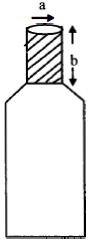
- 5A bottle has an opening of radius $a$ and length $b$. A cork of length band radius $\left( {a + \Delta a} \right)$ where $\left( {\Delta a < < a} \right)$ is compressed to fit into the opening completely (see figure). If the bulk modulus of cork is $B$ and frictional coefficient between the bottle and cork is $\mu $ then the force needed to push the cork into the bottle isView Solution
- 6View SolutionThere is no change in the volume of a wire due to change in its length on stretching. The poisson's ratio of the material of the wire is
- 7A force is applied to a steel wire ' $A$ ', rigidly clamped at one end. As a result elongation in the wire is $0.2\,mm$. If same force is applied to another steel wire ' $B$ ' of double the length and a diameter $2.4$ times that of the wire ' $A$ ', the elongation in the wire ' $B$ ' will be $............\times 10^{-2}\,mm$ (wires having uniform circular cross sections)View Solution
- 8View SolutionUnder elastic limit the stress is
- 9A uniform wire of length $L$ and radius $r$ is twisted by an angle $\alpha$. If modulus of rigidity of the wire is $\eta$, then the elastic potential energy stored in wire, is $.........$View Solution
- 10A wire elongates by $l$ $mm$ when a load $W$ is hanged from it. If the wire goes over a pulley and two weights $W$ each are hung at the two ends, the elongation of the wire will be (in $mm$)View Solution