MCQ
Under elastic limit the stress is 
  • A
    Inversely, proportional to strain
  • Directly proportional to strain
  • C
    Square root of strain
  • D
    Independent of strain

Answer

Correct option: B.
Directly proportional to strain
b
(b)

Need a full question paper?

Generate a complete, print-ready paper with questions like this in minutes — across 16+ boards, with answer keys.


Start Generating Free

Similar questions

In figure, two blocks $M$ and $m$ are tied together with an inextensible and light string. The mass $M$ is placed on a rough horizontal surface with coefficient of friction $\mu$ and the mass $m$ is hanging vertically against a smooth vertical wall. The pulley is frictionless. Choose the correct statement $(s)$ related to the tension $T$ in the string
A block of mass $10\, kg$ accelerates uniformly from rest to a speed of $2\, m/s$ in $20\, sec$. The average power developed in time interval of $0$ to $20\, sec$ is .............. $\mathrm{W}$
A large spherical mass $M$ is fixed at one position and two identical point masses $m$ are kept on a line passing through the centre of $M$ (see figure). The point masses are connected by a rigid massless rod of length $\ell$ and this assembly is free to move along the line connecting them. All three masses interact only through their mutual gravitational interaction. When the point mass nearer to $M$ is at a distance $r =3 \ell$ from $M$, the tension in the rod is zero for $m=k\left(\frac{M}{288}\right)$. The value of $k$ is
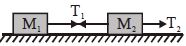
Two masses $M_1$ and $M_2$ are accelerated uniformly on a frictionless surface as shown in figure. The ratio of the tensions $T_1/T_2$ is 
When wavelength of incident photon is decreased then
If ${N_0}$ is the original mass of the substance of half life period ${T_{1/2}} = 5$ years, then the amount of substance left after $15$ years is
A particle moves in a circle of radius $25\, cm$ at two revolutions per second. The acceleration of the particle in meter/second$^2$ is
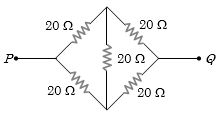
The equivalent resistance between $P$ and $Q$ in the given figure, is ............... $\Omega$
If the frequency of $K_\alpha X$-rays emitted from the element with atomic number $31$ is $v$ then the frequency of $K_\alpha X$-rays emitted from the element with atomic number $51$ would be
A ball is dropped from a height of $80\,m$ on a surface which is at rest. Find the height attainded by ball after $2^{nd}$ collision if coefficient of restitution $e = 0.5$ ............ $\mathrm{m}$