The Young's modulus of a wire of length $L$ and radius $r$ is $Y$. If the length is reduced to $\frac{L}{2}$ and radius is $\frac{r}{2}$ , then the Young's modulus will be
Easy
Download our app for free and get started
Young's modulus depends upon the nature of the material and not on geometrical dimensions

Download our appand get started for free
Experience the future of education. Simply download our apps or reach out to us for more information. Let's shape the future of learning together!No signup needed.*
Similar Questions
- 1View SolutionThe material which practically does not show elastic after effect is
- 2A copper solid cube of $60\,\, mm$ side is subjected to a pressure of $2.5 \times 10^7\, Pa$. If the bulk modulus of copper is $1.25 \times 10^{11}\, N/m^2$, the change in the volume of cube isView Solution
- 3Copper of fixed volume $V$ is drawn into wire of length $l$. When this wire is subjected to a constant force $F$, the extension produced in the wire is $\Delta l$. Which of the following graphs is a straight line?View Solution
- 4If one end of a wire is fixed with a rigid support and the other end is stretched by a force of $10 \,N,$ then the increase in length is $0.5\, mm$. The ratio of the energy of the wire and the work done in displacing it through $1.5\, mm$ by the weight isView Solution
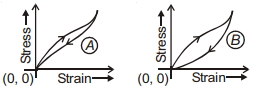
- 5View SolutionTwo different types of rubber are found to have the stress-strain curves as shown. Then
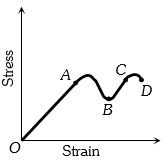
- 6View SolutionA graph is shown between stress and strain for a metal. The part in which Hooke's law holds good is
- 7View SolutionFour identical rods are stretched by same force. Maximum extension is produced in
- 8A steel wire is $1 \,m$ long and $1 \,mm ^2$ in area of cross$-$section. If it takes $200 \,N$ to stretch this wire by $1 \,mm$, how much force will be required to stretch a wire of the same material as well as diameter from its normal length of $10 \,m$ to a length of $1002 \,cm$ is $........ N$View Solution
- 9A metal rod of cross-sectional area $10^{-4} \,m ^{2}$ is hanging in a chamber kept at $20^{\circ} C$ with a weight attached to its free end. The coefficient of thermal expansion of the rod is $2.5 \times 10^{-6} \,K ^{-1}$ and its Young's modulus is $4 \times 10^{12} \,N / m ^{2}$. When the temperature of the chamber is lowered to $T$, then a weight of $5000 \,N$ needs to be attached to the rod, so that its length is unchanged. Then, $T$ is ............ $^{\circ} C$View Solution
- 10A glass slab is subjected to a pressure of $10\, atm$. The fractional change in its volume is (Bulk modulus of glass $= 37 \times 10^9\, N\, m^{-2}$, $1\, atm = 1 \times 10^5\, N\, m^{-2}$)View Solution