A metal rod of cross-sectional area $10^{-4} \,m ^{2}$ is hanging in a chamber kept at $20^{\circ} C$ with a weight attached to its free end. The coefficient of thermal expansion of the rod is $2.5 \times 10^{-6} \,K ^{-1}$ and its Young's modulus is $4 \times 10^{12} \,N / m ^{2}$. When the temperature of the chamber is lowered to $T$, then a weight of $5000 \,N$ needs to be attached to the rod, so that its length is unchanged. Then, $T$ is ............ $^{\circ} C$
KVPY 2019, Advanced
Download our app for free and get started
$(a)$ Length of rod given remains unchanged. This means contraction due to cooling is equals to elongation due to hanging of weight.
As, thermal strain $=$ strain caused by
$\alpha \Delta \theta=\frac{\Delta l}{l}$
$\Rightarrow \Delta \theta=\frac{\Delta l}{l\alpha}=\frac{F}{Y A} \quad\left(\because Y=\frac{F l }{A\Delta l}\right)$
$\Rightarrow \Delta \theta=\frac{5000}{4 \times 10^{12} \times 10^{-4} \times 2.5 \times 10^{-6}}=5^{\circ} C$
Note $\Delta \theta$ in $K$ is same as $\Delta \theta$ in ${ }^{\circ} C$.
$\therefore 20-T=5^{\circ} C \text { or } T=15^{\circ} C$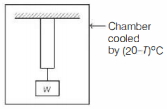

Download our appand get started for free
Experience the future of education. Simply download our apps or reach out to us for more information. Let's shape the future of learning together!No signup needed.*
Similar Questions
- 1A rod is fixed between two points at $20°C$. The coefficient of linear expansion of material of rod is $1.1 \times {10^{ - 5}}/^\circ C$ and Young's modulus is $1.2 \times {10^{11}}\,N/m$. Find the stress developed in the rod if temperature of rod becomes $10°C$View Solution
- 2A ball falling in a lake of depth $200\, m$ shows $0.1\%$ decrease in its volume at the bottom. What is the bulk modulus of the material of the ballView Solution
- 3View SolutionAfter effects of elasticity are maximum for
- 4Two wires $A$ and $B$ are of same materials. Their lengths are in the ratio $1 : 2$ and diameters are in the ratio $2 : 1$ when stretched by force ${F_A}$ and ${F_B}$ respectively they get equal increase in their lengths. Then the ratio ${F_A}/{F_B}$ should beView Solution
- 5The area of cross section of the rope used to lift a load by a crane is $2.5 \times 10^{-4} m ^{2}$. The maximum lifting capacity of the crane is $10$ metric tons. To increase the lifting capacity of the crane to $25$ metric tons, the required area of cross section of the rope should be.$.........\times 10^{-4} \,m ^{2}$ (take $g =10\, ms ^{-2}$ )View Solution
- 6Overall changes in volume and radii of a uniform cylindrical steel wire are $0.2 \%$ and $0.002 \%$ respectively when subjected to some suitable force. Longitudinal tensile stress acting on the wire is ($Y = 2.0 × 10^{11} Nm^{-2}$)View Solution
- 7An area of cross-section of rubber string is $2\,c{m^2}$. Its length is doubled when stretched with a linear force of $2 \times {10^5}$dynes. The Young's modulus of the rubber in $dyne/c{m^2}$ will beView Solution
- 8Two wires of copper having the length in the ratio $4 : 1$ and their radii ratio as $1 : 4$ are stretched by the same force. The ratio of longitudinal strain in the two will beView Solution
- 9The breaking stress of a wire of length $L$ and radius $r$ is $5$ $kg - wt/{m^2}$. The wire of length $2l$ and radius $2r$ of the same material will have breaking stress in $kg - wt/{m^2}$View Solution
- 10The maximum elongation of a steel wire of $1 \mathrm{~m}$ length if the elastic limit of steel and its Young's modulus, respectively, are $8 \times 10^8 \mathrm{~N} \mathrm{~m}^{-2}$ and $2 \times 10^{11} \mathrm{~N} \mathrm{~m}^{-2}$, is:View Solution