Question
There are certain material developed in laboratories which have a negative refractive index (Fig). A ray incident from air (medium 1) into such a medium (medium 2) shall follow a path given by:
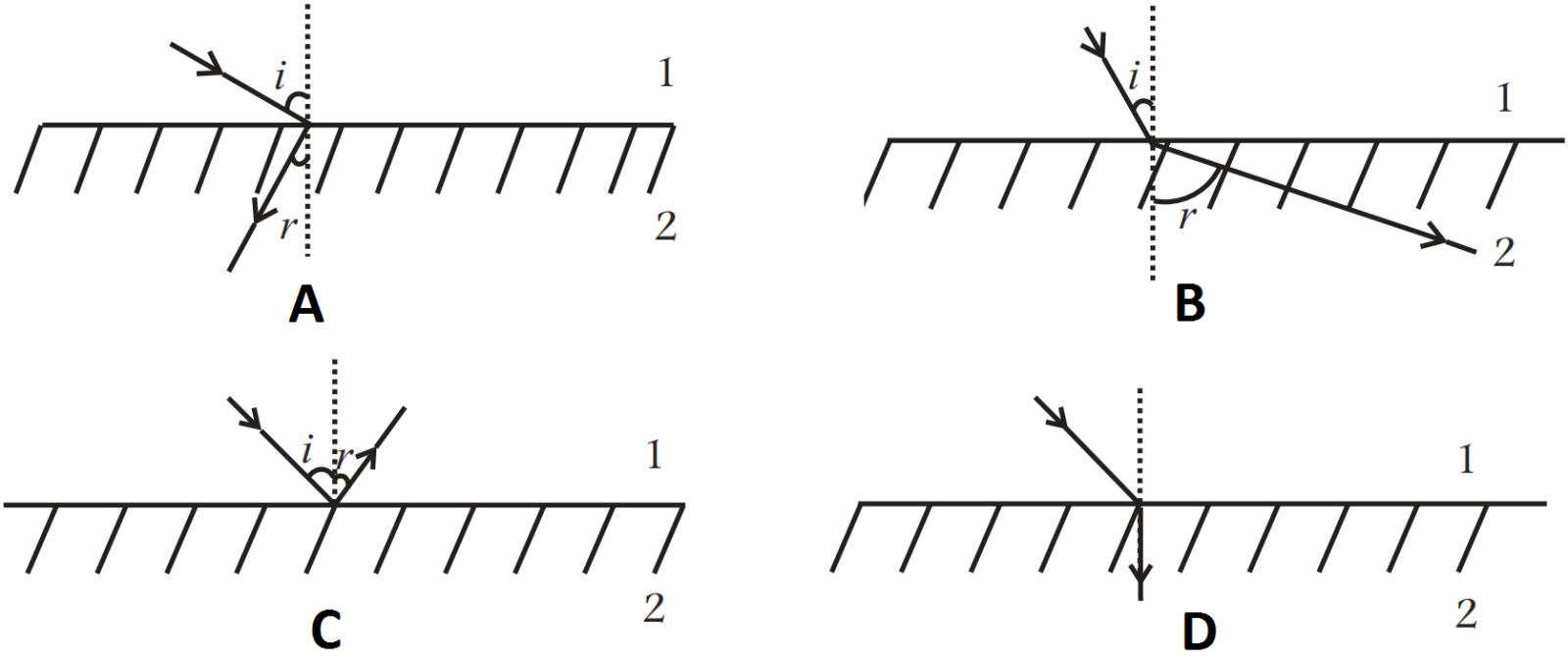
There are certain material developed in laboratories which have a negative refractive index (Fig). A ray incident from air (medium 1) into such a medium (medium 2) shall follow a path given by:
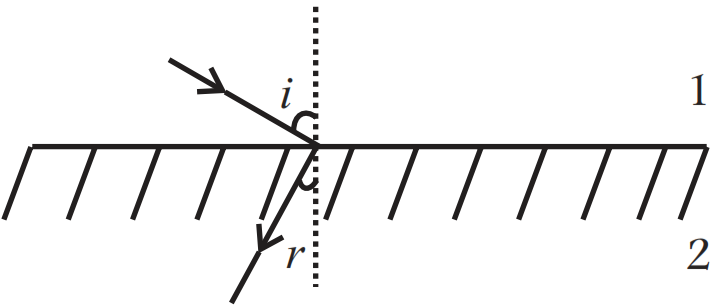
Solution:
The materials with negative refractive index responds to Snell’s law just opposite way. If incident ray from air (Medium 1) incident on those material, the ray refract or bend same side of the normal as in option (a).
Generate a complete, print-ready paper with questions like this in minutes — across 16+ boards, with answer keys.
In a sample of radioactive material, what fraction of the initial number of active nuclei will remain undisintegrated after half of a half-life of the sample
|
(a) |
(b) |
(c) |
(d) 2 |
The colour sequence in a carbon resistor is red, brown, orange and silver. The resistance of the resistor is
|
(a) 21 × 103 ± 10% |
(b) 23 × 101 ± 10 % |
(c) 21 × 103 ± 5% |
(d) 12 × 103 ± 5% |
Ten electrons are equally spaced and fixed around a circle of radius R. Relative to V = 0 at infinity, the electrostatic potential V and the electric field E at the centre C are
|
(a) V ≠ 0 and |
(b) V ≠ 0 and |
(c) V = 0 and |
(d) V = 0 and |
In the circuit shown, the point ‘B’ is earthed. The potential at the point ‘A’ is

|
(a) 14 V |
(b) 24 V |
(c) 26 V |
(d) 50 V |
The refractive index of water with respect to air is 4 / 3 and the refractive index of glass with respect to air is 3/2. The refractive index of water with respect to glass is
|
(a) |
(b) |
(c) |
(d) 2 |
When  electrons are removed from a neutral metal plate, the electric charge on it is
|
(a) – 1.6 C |
(b) + 1.6 C |
(c) 10 +19 C |
(d) 10–19 C |
The characteristic X-ray radiation is emitted, when
| (a) The electrons are accelerated to a fixed energy |
| (b) The source of electrons emits a monoenergetic beam |
|
(c) The bombarding electrons knock out electrons from the inner shell of the target atoms and one of the outer electrons falls into this vacancy |
|
(d) The valence electrons in the target atoms are removed as a result of the collision |
For a material, the refractive indices for red, violet and yellow colour light are respectively 1.52, 1.64 and 1.60. The dispersive power of the material is
|
(a) 2 |
(b) 0.45 |
(c) 0.2 |
(d) 0.045 |


