Question
There are energy bands in a solid. Do we have really continuous energy variation in a band or do we have very closely spaced but still discrete energy levels?

Answer

A solid consists of a combination of closely spaced energy levels. These energy levels are discrete but they have very small energy gap between two consecutive levels so they are referred as band. However, the energy levels in the band are discrete.

Need a full question paper?

Generate a complete, print-ready paper with questions like this in minutes — across 16+ boards, with answer keys.
Start Generating Free

Similar questions

  1. How does one explain the emission of electrons from a photosensitive surface with the help of Einstein's photoelectric equation?
  2. The work function of the following metals is given: Na 2.75ev, K = 2.3 eV, Mo = 4.17eV and Ni = 5.15eV. Which of these metals will not cause photoelectric emission for radiation of wavelength 3300 Å from a laser source placed 1m away from these metals? What happens if the laser source is brought nearer and placed 50cm away?
A traffic policeman standing on a road sounds a whistle emitting the main frequency of 2.00kHz. What could be the appparent frequency heard by a scooter-driver approaching the policeman at a speed of 36.0km/h? Speed of sound in air = 340m/s.
The electric field in a region is given by $\overrightarrow{\text{E}}=\frac{3}{5}\text{E}_0\overrightarrow{\text{i}}+\frac{4}{5}\text{E}_0\overrightarrow{\text{j}}$ with $\text{E}_0=2.0\times10^3\text{NC}^{-1}.$ Find the flux of this field through a rectangular surface of area $0.2m^2$ parallel to the y-z plane.
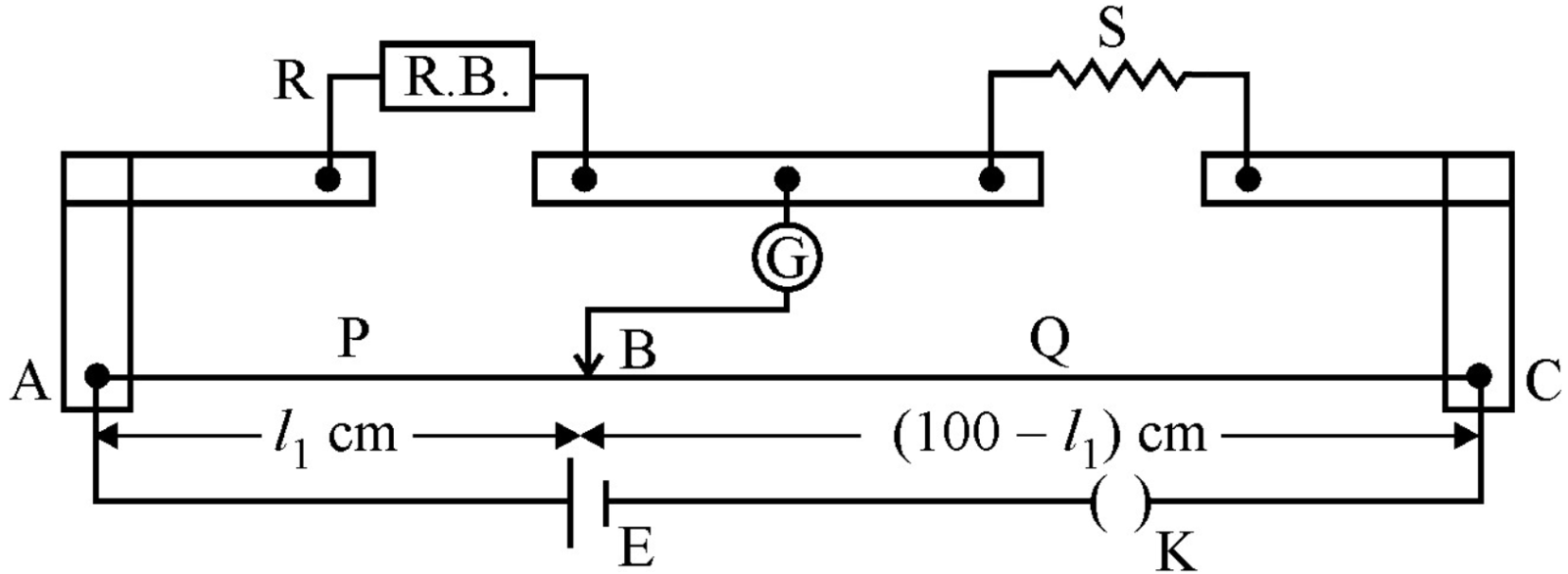
What is end error in a metre bridge? How is it overcome? The resistances in the two arms of the metre bridge are $\text{R}=5\Omega$ and S respectively. When the resistance S is shunted with an equal resistance, the new balance length found to be 1.5 $l_1$, where $l_1$ is the initial balancing length. Calculate the value of S.
A neutron is absorbed by a $^{6}_{3}\text{Li}$ nucleus with the subsequent emission of an alpha particle.
  1. Calculate the energy released, in MeV, in this reaction.
  2. Write the corresponding nuclear reaction.
Given: mass $^{6}_{3}\text{Li} =6015126 $ u; mass (neutron) =1.0086654 u; mass (alpha particle) = 4.0026044 u and mass (triton) = 3.0100000 u. Take $1\ u = 931\ MeV/C^2.$
A light ray is incident at an angle of 45° with the normal to a $\sqrt{2}\text{cm}$ thick plate $(\mu = 2.0)$. Find the shift in the path of the light as it emerges out from the plate.
Two heating elements of resistances $R_1$ and $R_2$ when operated at a constant supply of voltage, V, Consume power $P_1$ and $P_2 $ respectively. Deduce the expressions for the power of their combination when they are, in turn, connected in (i) series and (ii) parallel across the same voltage supply.
We have valence electrons and conduction electrons in a semiconductor. Do we also have 'valence holes' and 'conduction holes'?
Given n resistors each of resistance R, how will you combine them to get the (i) maximum (ii) minimum effective resistance? What is the ratio of the maximum to minimum resistance?
Suppose a monochromatic X-ray beam of wavelength 100pm is sent through a Young's double slit and the interference pattern is observed on a photographic plate placed 40cm away from the slit. What should be the separation between the slits so that the successive maxima on the screen are separated by a distance of 0.1mm?