There are three voltmeters of the same range but of resistances $10000\,\Omega $, $8000\,\Omega $ and $4000\,\Omega $ respectively. The best voltmeter among these is the one whose resistance is ................ $\Omega $
Medium
Download our app for free and get started
(a) Resistance of voltmeter should be high.

Download our appand get started for free
Experience the future of education. Simply download our apps or reach out to us for more information. Let's shape the future of learning together!No signup needed.*
Similar Questions
- 1A beam of protons with speed $4 \times 10^{5}\, ms ^{-1}$ enters a uniform magnetic field of $0.3\, T$ at an angle of $60^{\circ}$ to the magnetic field. The pitch of the resulting helical path of protons is close to....$cm$View Solution
(Mass of the proton $=1.67 \times 10^{-27}\, kg$, charge of the proton $=1.69 \times 10^{-19}\,C$)
- 2A proton (mass $ = 1.67 \times {10^{ - 27}}\,kg$ and charge $ = 1.6 \times {10^{ - 19}}\,C)$ enters perpendicular to a magnetic field of intensity $2$ $weber/{m^2}$ with a velocity $3.4 \times {10^7}\,m/\sec $. The acceleration of the proton should beView Solution
- 3View SolutionThe phosphor bronze strip is used in a moving coil galvanometer because
- 4A charge $Q$ is uniformly distributed over the surface of nonconducting disc of radius $R$. The disc rotates about an axis perpendicular to its plane and passing through its centre with an angular velocity $\omega$. As a result of this rotation a magnetic field ofinduction $B$ is obtained at the centre of the disc. If we keep both the amount of charge placed on the disc and its angular velocity to be constant and vary the radius of the disc then the variation of the magnetic induction at the centre of the disc will be represented by the figureView Solution
- 5A long, straight wire of radius $a$ carries a current distributed uniformly over its cross-section. The ratio of the magnetic fields due to the wire at distance $\frac{a}{3}$ and $2 a,$ respectively from the axis of the wire isView Solution
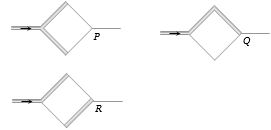
- 6Two thick wires and two thin wires, all of the same materials and same length form a square in the three different ways $P$, $Q$ and $R$ as shown in fig with current connection shown, the magnetic field at the centre of the square is zero in casesView Solution
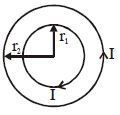
- 7Two circular concentric loops of radii $r_1 = 20\,cm$ and $r_2 = 30\,cm$ are placed in the $X, Y-$ plane as shown in the figure. A current $I = 7\,amp$ is flowing through them. The magnetic moment of this loop system isView Solution
- 8A magnet of magnetic moment $50 \hat i\, Am^2$ is placed along the $x-$ axis in a magnetic field $\vec B = (0.5\hat i + 3.0\hat j)\,T$. The torque acting on the magnet isView Solution
- 9Two coaxial solenoids of different radii carry current $I$ in the same direction. Let $\;{\overrightarrow {\;F} _1}$ be the magnetic force on the inner solenoid due to the outer one and $\;{\overrightarrow {\;F} _2}$ be the magnetic force on the outer solenoid due to the inner one. ThenView Solution
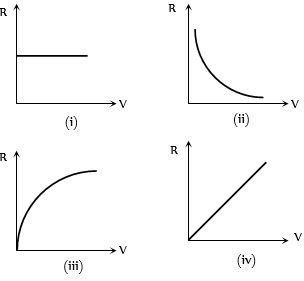
- 10The graph which represents the relation between the total resistance $R$ of a multi range moving coil voltmeter and its full scale deflection $V$ isView Solution