Question
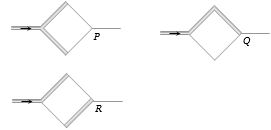
Two thick wires and two thin wires, all of the same materials and same length form a square in the three different ways $P$, $Q$ and $R$ as shown in fig with current connection shown, the magnetic field at the centre of the square is zero in cases
Answer

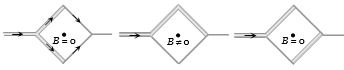
(d) In $P$ and $R$ loops, currents are divided in same proportion because the branches have equal resistance. Hence magnetic field produced at centre due to each segment is of equal magnitude but of opposite direction, so net field is zero.

Need a full question paper?

Generate a complete, print-ready paper with questions like this in minutes — across 16+ boards, with answer keys.

Start Generating Free

Similar questions

In an amplifier the load resistance ${R_L}$ is equal to the plate resistance $({r_p})$. The voltage amplification is equal to
A spherical drop of capacitance $1\,\,\mu F$ is broken into eight drops of equal radius. Then, the capacitance of each small drop is ......$\mu F$
The radius of circular path of an electron when subjected to a perpendicular magnetic field is
Four charges equal to $-Q$ are placed at the four corners of a square and a charge $q$ is at its centre. If the system is in equilibrium the value of $q$ is
To maintain a speed of $80\,km / h$ by a bus of mass $500\,kg$ on a plane rough road for $4\,km$ distance, the work done by the engine of the bus will be $........\,kJ$. [The coefficient of friction between tyre of bus and road is $0.04]$.
List-$I$ List-$II$
$(a)$ $MI$ of the rod (length ${L}$, Mass ${M}$, about an axis $\perp$ to the rod passing through the midpoint) $(i)\;\frac {8 {ML}^{2}}{3}$
$(b)$ MI of the rod (length $L$, Mass $2 M$, about an axis $\perp$ to the rod Passing through one its end) $(ii)\;\frac {{ML}^{2}}{3}$
$(c)$ MI of the rod (length $2 {L}$, Mass ${M}$, about an axis $\perp$ to the rod  Passing through its midpoint) $(iii)\;\frac {{ML}^{2}}{12}$
$(d)$ MI of the rod (length $2 {L}$, Mass $2 {M}$, about an axis $\perp$ to the rod  passing through one of its end) $(iv)\;\frac {2 {ML}^{2}}{3}$

 Choose the correct answer from the options given below

Consider a mercury-filled tube as shown in the figure below 

Which of the following options about the pressures at the lettered locations $(A, B, C, D)$ is true?

The equation of stationary wave along a stretched string is given by $y = 5\sin \frac{{\pi x}}{3}\cos 40\pi t$ where $x$ and $y$ are in centimetre and $t$ in second. The separation between two adjacent nodes is .... $cm$
Two radioactive samples $A$ and $B$ have half lives $T_1$ and $T_2\left(T_1 > T_2\right)$ respectively At $t=0$, the activity of $B$ was twice the activity of $A$. Their activity will become equal after a time
Two light wave of intensities $I_0$ and $9I_0$ superpose at a point to produce a resultant intensity of $7I_0$. Calculate phase difference between light waves