Four identical hollow cylindrical columns of mild steel support a big structure of mass $50 \times 10^{3} {kg}$, The inner and outer radii of each column are $50\; {cm}$ and $100 \;{cm}$ respectively. Assuming uniform local distribution, calculate the compression strain of each column. [Use $\left.{Y}=2.0 \times 10^{11} \;{Pa}, {g}=9.8\; {m} / {s}^{2}\right]$
JEE MAIN 2021, Diffcult


Download our appand get started for free
Experience the future of education. Simply download our apps or reach out to us for more information. Let's shape the future of learning together!No signup needed.*
Similar Questions
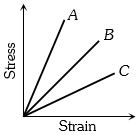
- 1The stress-strain curves for brass, steel and rubber are shown in the figure. The lines $A, B$ and $C$ are forView Solution
- 2View SolutionThe elasticity of invar
- 3A steel wire of diameter $0.5 mm$ and Young's modulus $2 \times 10^{11} N m ^{-2}$ carries a load of mass $M$. The length of the wire with the load is $1.0 m$. A vernier scale with $10$ divisions is attached to the end of this wire. Next to the steel wire is a reference wire to which a main scale, of least count $1.0 mm$, is attached. The $10$ divisions of the vernier scale correspond to $9$ divisions of the main scale. Initially, the zero of vernier scale coincides with the zero of main scale. If the load on the steel wire is increased by $1.2 kg$, the vernier scale division which coincides with a main scale division is. . . . Take $g =10 m s ^{-2}$ and $\pi=3.2$.View Solution
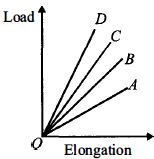
- 4View SolutionThe load versus elongation graphs for four wires of same length and made of the same material are shown in the figure. The thinnest wire is represented by the line
- 5Auniform rod rotating in gravity free region with certain constant angular velocity. The variation of tensile stress with distance $x$ from axis of rotation is best represented by which of the following graphs.View Solution
- 6The upper end of a wire of radius $4\, mm$ and length $100\, cm$ is clamped and its other end is twisted through an angle of $30°$. Then angle of shear is ..... $^o$View Solution
- 7View SolutionAccording to Hook’s law of elasticity, if stress is increased, the ratio of stress to strain
- 8The Young's modulus of a wire is $Y.$ If the energy per unit volume is $E$, then the strain will beView Solution
- 9A rod of length $l$ and radius $r$ is joined to a rod of length $l/2$ and radius $r/2$ of same material. The free end of small rod is fixed to a rigid base and the free end of larger rod is given a twist of $\theta°$, the twist angle at the joint will beView Solution
- 10The bulk modulus of rubber is $9.1 \times 10^8\,N/m^2$. To what depth a rubber ball be taken in a lake so that its volume is decreased by $0.1\%$ ? ....... $m$View Solution