There are two wires of same material and same length while the diameter of second wire is $2$ times the diameter of first wire, then ratio of extension produced in the wires by applying same load will be
Medium


Download our appand get started for free
Experience the future of education. Simply download our apps or reach out to us for more information. Let's shape the future of learning together!No signup needed.*
Similar Questions
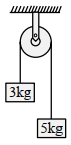
- 1Two blocks of masses $3 \,{kg}$ and $5\, {kg}$ are connected by a metal wire going over a smooth pulley. The breaking stress of the metal is $\frac{24}{\pi} \times 10^{2}\, {Nm}^{-2}$. What is the minimum radius of the wire? (Take $\left.g=10\, {ms}^{-2}\right)$ (in $cm$)View Solution
- 2View SolutionWhich of the following relations is true
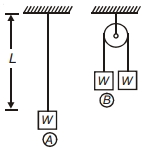
- 3If in case $A$, elongation in wire of length $L$ is $l$, then for same wire elongation in case $B$ will be ......View Solution
- 4A steel wire of lm long and $1\,m{m^2}$ cross section area is hang from rigid end. When weight of $1\,kg$ is hung from it then change in length will be given ..... $mm$ $(Y = 2 \times {10^{11}}N/{m^2})$View Solution
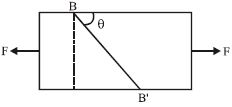
- 5A bar of cross-sectional area $A$ is subjected two equal and opposite tensile forces at its ends as shown in figure. Consider a plane $BB'$ making an angle $\theta $ with the length The ratio of tensile stress to the shearing stress on the plane $BB'$ isView Solution
- 6View SolutionThe dimensions of four wires of the same material are given below. In which wire the increase in length will be maximum when the same tension is applied
- 7$A$ and $B$ are two wires. The radius of $A$ is twice that of $B.$ They are stretched by the some load. Then the stress on $B$ isView Solution
- 8A cube of metal is subjected to a hydrostatic pressure of $4\;GPa.$ The percentage change in the length of the side of the cube is close to.......$\%$View Solution
(Given bulk modulus of metal, $B =8 \times 10^{10}\, Pa$ ) - 9A steel rod has a radius of $20\,mm$ and a length of $2.0\,m$. A force of $62.8\,kN$ stretches it along its length. Young's modulus of steel is $2.0 \times 10^{11}\,N / m ^2$. The longitudinal strain produced in the wire is $..........\times 10^{-5}$View Solution
- 10Two wires are made of the same material and have the same volume. However wire $1$ has crosssectional area $A$ and wire $2$ has cross-section area $3A$. If the length of wire $1$ increases by $\Delta x$ on applying force $F$, how much force is needed to stretch wire $2$ by the same amount?View Solution