There exists an electric field of magnitude $E$ in $x$-direction. If the work done in moving a charge of $0.2 \,C$ through a distance of $2 \,m$ along a line making an angle $60^{\circ}$ with $x$-axis is $4 \,J$, then the value of $E$ is ........ $N / C$
Easy



Download our appand get started for free
Experience the future of education. Simply download our apps or reach out to us for more information. Let's shape the future of learning together!No signup needed.*
Similar Questions
- 1The work which is required to be done to make an arrangement of four particles each having a charge $+q$ such that the particles lie at the four corners of a square of side $a$ is .......View Solution
- 2A parallel plate capacitor of plate area $A$ and plate seperation $d$ is charged to potential difference $V$ and then the battery is disconnected. Aslab of dielectric constant $K$ is then inserted between the plates of the capacitor so as to fill the space between the plates. If $Q, E$ and $W$ denote respectively, the magnitude of charge on each plate, the electric field between the plates (after the slab is inserted) and the work done on the system, in question, in the process of inserting the slab, thenView Solution
- 3A parallel plate capacitor has plates with area $A$ and separation $d$ . A battery charges the plates to a potential difference $V_0$ . The battery is then disconnected and a dielectric slab of thickness $d$ is introduced. The ratio of energy stored in the capacitor before and after the slab is introduced, isView Solution
- 4Two parallel plate condensers of capacity of $20 \mu F$ and $30 \mu F$ are charged to the potentials of $30V$ and $20V$ respectively. If likely charged plates are connected together then the common potential difference will be :-......$V$View Solution
- 5The distance between the plates of a charged parallel plate capacitor is $5\ cm$ and electric field inside the plates is $200\ Vcm^{-1}$. An uncharged metal bar of width $2\ cm$ is fully immersed into the capacitor. The length of the metal bar is same as that of plate of capacitor. The voltage across capacitor after the immersion of the bar is......$V$View Solution
- 6A $10\ \mu F$ capacitor is charged to a potential difference of $1000\ V$. The terminals of the charged capacitor are disconnected from the power supply and connected to the terminals of an uncharged $6\ \mu F$ capacitor. What is the final potential difference across each capacitor.....$V$View Solution
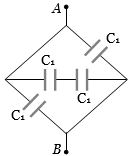
- 7Four identical capacitors are connected as shown in diagram. When a battery of $6 V$ is connected between $A$ and $B$, the charge stored is found to be $1.5\, \mu C$. The value of ${C_1}$ is........$\mu F$View Solution
- 8View SolutionWhen a parallel plates capacitor is connected to a source of constant potential difference,
- 9An electric charge $10^{-3}$ $\mu C$ is placed at the origin $(0, 0) $ of $X - Y$ co-ordinate system. Two points $A$ and $B$ are situated at $\left( {\sqrt 2 ,\sqrt 2 } \right)$ and $(2,0)$ respectively. The potential difference between the points $A$ and $B$ will be.......$V$View Solution
- 10The two plates $X $ and $Y$ of a parallel plate capacitor of capacitance $C$ are given a charge of amount $Q$ each. $X$ is now joined to the positive terminal and $Y$ to the negative terminal of a cell of $emf$ $E = Q/C$.View Solution