There is a $1$ $mm $ thick layer of glycerine between a flat plate of area $100$ $cm^2$ $\&$ a big fixed plate. If the coefficient of viscosity of glycerine is $1.0$ $kg/m^{-s}$ then ....... $N$ force is required to move the plate with a velocity of $7$ $cm/s$ ?
Easy
Download our app for free and get started
Using the relation $\tau=\frac{F}{A}=\mu \frac{d u}{d y}$
where $F=$ force is required to move the plate
$\tau=$ Shear stress
$A=$ Area of plate
$\mu=$ coeffecient of viscosity of glycerine
$y=g a p$
$\mathrm{u}=$ velocity
$\frac{F}{10^{-2}}=1 \times \frac{0.07}{0.001}$
Thus $F=0.7 \mathrm{N}$

Download our appand get started for free
Experience the future of education. Simply download our apps or reach out to us for more information. Let's shape the future of learning together!No signup needed.*
Similar Questions
- 1A hollow cone floats with its axis vertical upto one-third of its height in a liquid of relative density $0.8$ and with its vertex submerged. When another liquid of relative density $\rho$ is filled in it upto one-third of its height, the cone floats upto half its vertical height. The height of the cone is $0.10$ $m$ and the radius of the circular base is $0.05$ $m$. The specific gravity $\rho$ is given byView Solution
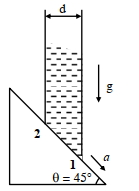
- 2A cylindrical tube, with its base as shown in the figure, is filled with water. It is moving down with a constant acceleration $a$ along a fixed inclined plane with angle $\theta=45^{\circ} . P_1$ and $P_2$ are pressures at points 1 and 2 , respectively, located at the base of the tube. Let $\beta=\left(P_1-P_2\right) /(\rho g d)$, where $\rho$ is density of water, $d$ is the inner diameter of the tube and $g$ is the acceleration due to gravity. Which of the following statement($s$) is(are) correct?View Solution
$(A)$ $\beta=0$ when $a= g / \sqrt{2}$
$(B)$ $\beta>0$ when $a= g / \sqrt{2}$
$(C)$ $\beta=\frac{\sqrt{2}-1}{\sqrt{2}}$ when $a= g / 2$
$(D)$ $\beta=\frac{1}{\sqrt{2}}$ when $a= g / 2$
- 3Two water pipes $P$ and $Q$ having diameters $2$$ \times 10^{-2} $ $m$ and $4$ $\times 10^{-2}$ $m$, respectively, are joined in series with the main supply line of water. The velocity of water flowing in pipe $P$ isView Solution
- 4A barometer kept in an elevator reads $76 \,cm$ when it is at rest. If the elevator goes up with some acceleration, the reading will be .......... $cm$View Solution
- 5A hot air balloon is carrying some passengers, and a few sandbags of mass $1 kg$ each so that its total mass is $480 kg$. Its effective volume giving the balloon its buoyancy is $V$. The balloon is floating at an equilibrium height of $100 m$. When $N$ number of sandbags are thrown out, the balloon rises to a new equilibrium height close to $150 m$ with its volume $V$ remaining unchanged. If the variation of the density of air with height $h$ from the ground is $\rho(h)=\rho_0 e^{-\frac{h}{h_0}}$, where $\rho_0=1.25 kg m ^{-3}$ and $h _0=6000 m$, the value of $N$ is. . . . .View Solution
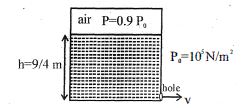
- 6A closed vessel have a small hole in one face of vessel near the bottom as shown. The velocity of water coming out from the given hole at given instant is ....... $m/s$View Solution
- 7View SolutionTo get the maximum flight, a ball must be thrown as
- 8View SolutionIn the case of a fluid, Bernoulli's theorem expresses the application of the principle of conservation of :
- 9A beaker containing a liquid of density $\rho $ moves up with an acceleration $a$ ; the pressure due to the liquid at a depth $h$ below the free surface of the liquid isView Solution
- 10$Assertion :$ Falling raindrops acquire a terminal velocity.View Solution
$Reason :$ A constant force in the direction of motion and a velocity dependent force opposite to the direction of motion, always result in the acquisition of terminal velocity.