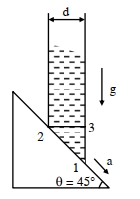
A cylindrical tube, with its base as shown in the figure, is filled with water. It is moving down with a constant acceleration $a$ along a fixed inclined plane with angle $\theta=45^{\circ} . P_1$ and $P_2$ are pressures at points 1 and 2 , respectively, located at the base of the tube. Let $\beta=\left(P_1-P_2\right) /(\rho g d)$, where $\rho$ is density of water, $d$ is the inner diameter of the tube and $g$ is the acceleration due to gravity. Which of the following statement($s$) is(are) correct?
$(A)$ $\beta=0$ when $a= g / \sqrt{2}$
$(B)$ $\beta>0$ when $a= g / \sqrt{2}$
$(C)$ $\beta=\frac{\sqrt{2}-1}{\sqrt{2}}$ when $a= g / 2$
$(D)$ $\beta=\frac{1}{\sqrt{2}}$ when $a= g / 2$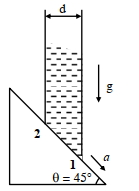
IIT 2021, Advanced


Download our appand get started for free
Experience the future of education. Simply download our apps or reach out to us for more information. Let's shape the future of learning together!No signup needed.*
Similar Questions
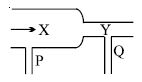
- 1A steady flow of water passes along a horizontal tube from a wide section $X$ to the narrower section $Y$, see figure. Manometers are placed at $P$ and $Q$ at the sections. Which of the statements $A, B, C, D, E$ is most correct?View Solution
- 2If $\rho$ is the density and $\eta$ is coefficient of viscosity of fluid which flows with a speed $v$ in the pipe of diameter $d$, the correct formula for Reynolds number $R _{ e }$ is ..............View Solution
- 3A liquid is kept in a cylindrical vessel which is being rotated about a vertical axis through the centre of the circular base. If the radius of the vessel is $ r $ and angular velocity of rotation is $\omega $, then the difference in the heights of the liquid at the centre of the vessel and the edge isView Solution
- 4View SolutionA large ship can float but a steel needle sinks because of
- 5An aeroplane of mass $3 \times 10^4\, kg$ and total wing area of $120\, m^2$ is in a level flight at some height. The difference in pressure between the upper and lower surfaces of its wings in kilopascals is $(g=10\,m/s^2)$View Solution
- 6The top of a water tank is open to air and its water level is maintained. It is giving out $0.74\,m^3$ water per minute through a circular opening of $2\,cm$ radius in its wall. The depth of the centre of the opening from the level of water in the tank is close to........ $m$View Solution
- 7A block of wood floats in water with $\frac{4}{5}$ th of its volume submerged, but it just floats in another liquid. The density of liquid is (in $kg / m ^3$ )View Solution
- 8In Millikan's oil drop experiment, what is viscous force acting on an uncharged drop of radius $2.0 \times 10^{-5}\, {m}$ and density $1.2 \times 10^{3} \,{kgm}^{-3}$ ? Take viscosity of liquid $=1.8 \times 10^{-5}\, {Nsm}^{-2} .$ (Neglect buoyancy due to air).View Solution
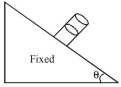
- 9A cylindrical vessel filled with water is released on an inclined surface of angle $\theta$ as shown in figure.The friction coefficient of surface with vessel is $\mu( < \tan \theta)$.Then the contact angle made by the surface of water with the incline will beView Solution
- 10The water is filled upto height of $12\, {m}$ in a tank having vertical sidewalls. A hole is made in one of the walls at a depth $'{h}'$ below the water level. The value of $'h'$ for which the emerging stream of water strikes the ground at the maximum range is $.....\,{m}$.View Solution