There is a black spot on a body. If the body is heated and carried in dark room then it glows more. This can be explained on the basis of
Easy


Download our appand get started for free
Experience the future of education. Simply download our apps or reach out to us for more information. Let's shape the future of learning together!No signup needed.*
Similar Questions
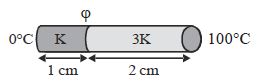
- 1Two bars of thermal conductivities $K$ and $3K$ and lengths $1\,\, cm$ and $2\,\, cm$ respectively have equal cross-sectional area, they are joined lengths wise as shown in the figure. If the temperature at the ends of this composite bar is $0\,^oC$ and $100\,^oC$ respectively (see figure), then the temperature $\varphi $ of the interface is......... $^oC$View Solution
- 2A sphere, a cube and a thin circular plate, all made of the same mass and finish are heated to a temperature of $200^{\circ} C$. Which of these objects will cool slowest, when left in air at room temperature?View Solution
- 3A black body radiates energy at the rate of $E$ $W/m^2$ at a high temperature $TK$ . When the temperature is reduced to $\frac{T}{2}K$, the radiant energy will beView Solution
- 4body radiates energy $5W$ at a temperature of ${127^o}C$. If the temperature is increased to ${927^o}C$, then it radiates energy at the rate of ...... $W$View Solution
- 5An incandescent bulb has a thin filament of tungsten that is heated to high temperature by passing an electric current. The hot filament emits black-body radiation. The filament is observed to break up at random locations after a sufficiently long time of operation due to non-uniform evaporation of tungsten from the filament. If the bulb is powered at constant voltage, which of the following statement($s$) is(are) true?View Solution
($A$) The temperature distribution over the filament is uniform
($B$) The resistance over small sections of the filament decreases with time
($C$) The filament emits more light at higher band of frequencies before it breaks up
($D$) The filament consumes less electrical power towards the end of the life of the bulb
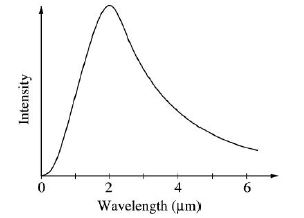
- 6The distribution of relative intensity $I (\lambda)$ of blackbody radiation from a solid object versus the wavelength $\lambda$ is shown in the figure. If the Wien displacement law onstant is $2.9 × 10^{-3}\ mK$, what is the approximate temperature of the object ....... $K$View Solution
- 7A black coloured solid sphere of radius $R$ and mass $M$ is inside a cavity with vacuum inside. The walls of the cavity are maintained at temperature $T_0$. The initial temperature of the sphere is $3T_0$. If the specific heat of the material of the sphere varies as $\alpha T^3$ per unit mass with the temperature $T$ of the sphere, where $\alpha $ is a constant, then the time taken for the sphere to cool down to temperature $2T_0$ will be ( $\sigma $ is Stefan Boltzmann constant)View Solution
- 8When $p$ calories of heat is given to a body, it absorbs $q$ calories; then the absorbtion power of body will beView Solution
- 9Instantaneous temperature difference between cooling body and the surroundings obeying Newton's law of cooling is $\theta$. Which of the following represents the variation of $\ln \theta$ with time $t$ ?View Solution
- 10A black body is at a temperature of $5760\ K$. The energy of radiation emitted by the body at wavelength $250\ nm$ is $U_1$, at wavelength $500\ nm$ is $U_2$ and that at $1000\ nm$ is $U_3$. Wien's constant, $b = 2.88 \times 10^6\ nm\ K$. Which of the following is correct?View Solution