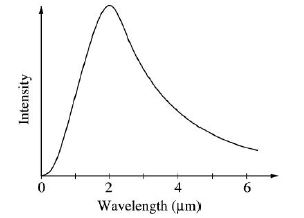
The distribution of relative intensity $I (\lambda)$ of blackbody radiation from a solid object versus the wavelength $\lambda$ is shown in the figure. If the Wien displacement law onstant is $2.9 × 10^{-3}\ mK$, what is the approximate temperature of the object ....... $K$
A$10$
B$50$
C$250$
D$1500$
Medium
Download our app for free and get started
D$1500$
d ${\lambda _m}T$ = constant
Download our app
and get started for free
Experience the future of education. Simply download our apps or reach out to us for more information. Let's shape the future of learning together!No signup needed.*
If wavelengths of maximum intensity of radiations emitted by the sun and the moon are $0.5 \times {10^{ - 6}}m$ and ${10^{ - 4}}m$ respectively, the ratio of their temperatures is
A black body, at a temperature of $227\,^oC$ radiates heat at a rate of $7\,cal\,cm^{-2}\, s^{-1}$ . At a temperature of $727\,^oC$ , the rate of heat radiated in the same units will be
The temperature of a body falls from ${50^o}C$to ${40^o}C$ in $10$ minutes. If the temperature of the surroundings is ${20^o}C$ Then temperature of the body after another $10$ minutes will be ........ $^oC$
A body initially at $80^o C$ cools to $64^o C$ in $5$ minutes and to $52^o C$ in $10 $ minutes. The temperature of the body after $15$ minutes will be ...... $^oC$
Water and turpentine oil (specific heat less than that of water) are both heated to same temperature. Equal amounts of these placed in identical calorimeters are then left in air
A constant potential difference is applied to the ends of a graphite rod, whose resistance decreases with a rise of temperature. The rod can be $(1)$ covered with asbestos or $(2)$ left open to atmosphere. Answer for steady state.
In the Arctic region, hemispherical houses called Igloos are made of ice. It is possible to maintain a temperature inside an Igloo as high as $20^{\circ} C$ because