There is a current of $1.344\, amp$ in a copper wire whose area of cross-section normal to the length of the wire is $1\,m{m^2}$. If the number of free electrons per $c{m^3}$ is $8.4 \times {10^{22}}$, then the drift velocity would be
Easy
Download our app for free and get started
(c) ${v_d} = \frac{i}{{nAe}} = \frac{{1.344}}{{{{10}^{ - 6}} \times 1.6 \times {{10}^{ - 19}} \times 8.4 \times {{10}^{22}}}}$
$ = \frac{{1.344}}{{10 \times 1.6 \times 8.4}} = 0.01\,cm/s = 0.1\,mm/s$

Download our appand get started for free
Experience the future of education. Simply download our apps or reach out to us for more information. Let's shape the future of learning together!No signup needed.*
Similar Questions
- 1In a meter bridge experiment null point is obtained at $20\, cm$ from one end of the wire when resistance $X$ is balanced against another resistance $Y$. If $X < Y$, then where will be the new position of the null point from the same end, if one decides to balance a resistance of $4X$ against $Y$ ........... $cm$View Solution
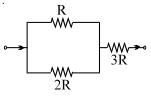
- 2The ratio of powers dissipatted respectively in $R$ and $3R$, as shown is:View Solution
- 3When the resistance of $9 \,\Omega$ is connected at the ends of a battery, its potential difference decreases from $40\, volt$ to $30\, volt$. The internal resistance of the battery is ............... $\Omega$View Solution
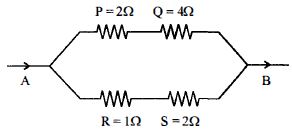
- 4Which of the four resistances $P, Q, R$ and $S$ generate the greatest amount of heat when a current flows from $A$ to $B$ ?View Solution
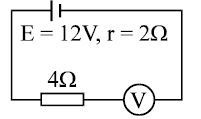
- 5By error, a student places moving-coil voltmeter $V$ (nearly ideal) in series with the resistance in a circuit in order to read the current, as shown. The voltmeter reading will be ............ $V$View Solution
- 6Wheatstone bridge principle is used to measure the specific resistance $\left(S_1\right)$ of given wire, having length $L$, radius $r$. If $X$ is the resistance of wire, then specific resistance is: $S_1=X\left(\frac{\pi r^2}{L}\right)$. If the length of the wire gets doubled then the value of specific resistance will be :View Solution
- 7In a meter bridge, the balancing length from the left end (standard resistance of $1 \,ohm$ is in the right gap) is found to be $20\, cm$. The value of the unknown resistance is ............... $\Omega$View Solution
- 8The resistance of a $5\, cm$ long wire is $10\, \Omega$. It is uniformly stretched so that its length becomes $20\, cm$. The resistance of the wire is ............. $\Omega$View Solution
- 9A $16\, \Omega$ wire is bend to form a square loop. A $9 \,{V}$ supply having internal resistance of $1 \,\Omega$ is connected across one of its sides. The potential drop across the diagonals of the square loop is $.......\,\times 10^{-1} \,{V}$View Solution
- 10For the arrangement of the potentiometer shown in the figure, the balance point is obtained at $a$ distance $75\,cm $ from $A$ when the key $k$ is open. The second balance point is obtained at $60\, cm$ from $A$ when the key $k$ is closed. Find the internal resistance (in $ \Omega$) of the battery $E_1$.View Solution