MCQ
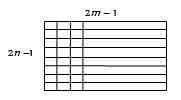
There is a rectangular sheet of dimension $(2m - 1) × (2n - 1)$, (where $m > 0,n > 0)$. It has been divided into square of unit area by drawing lines perpendicular to the sides. Find number of rectangles having sides of odd unit length
  • A
    ${(m + n + 1)^2}$
  • B
    $mn(m + 1)\,(n + 1)$
  • C
    ${4^{m + n - 2}}$
  • ${m^2}{n^2}$

Answer

Correct option: D.
${m^2}{n^2}$
d
(d) Along horizontal side one unit can be taken in $(2m-1)$ ways and $3$ unit side can be taken in $2m - 3$ ways.

The number of ways of selecting a side horizontally is

$(2m - 1 + 2m - 3 + 2m - 5 + .... + 3 + 1)$

Similarly the number of ways along vertical side is $(2n - 1 + 2n - 3 + .... + 5 + 3 + 1)$.

$\therefore$ Total number of rectangles

$ = [1 + 3 + 5 + ..... + (2m - 1)] \times [1 + 3 + 5 + .... + (2n - 1)]$

$ = \frac{{m(1 + 2m - 1)}}{2} \times \frac{{n(1 + 2n - 1)}}{2} = {m^2}{n^2}$.

Need a full question paper?

Generate a complete, print-ready paper with questions like this in minutes — across 16+ boards, with answer keys.

Start Generating Free

Similar questions

$\mathop {\lim }\limits_{x \to 1} \frac{{\log x}}{{x - 1}} = $
The equation $z\overline z + (2 - 3i)z + (2 + 3i)\overline z + 4 = 0$ represents a circle of radius
The locus of the centre of a circle which touches externally the circle ${x^2} + {y^2} - 6x - 6y + 14 = 0$ and also touches the $y$-axis, is given by the equation
Three integers are chosen at random from the first 20 integers. The probability that their product is even is:
The expression $[x + (x^3-1)^{1/2}]^5 + [x - (x^3-1)^{1/2}]^5$ is a polynomial of degree :
The angle of intersection between the curves ${y^2} = 4x$ and ${x^2} = 32y$ at point $(16, 8)$, is
$(1 - \omega + {\omega ^2})(1 - {\omega ^2} + {\omega ^4})(1 - {\omega ^4} + {\omega ^8})...........$to $2n$ factors is
For a non-zero complex number $z$, let $\arg ( z )$ denote the principal argument with $-\pi<\arg ( z ) \leq \pi$. Then, which of the following statement (s) is (are) $FALSE$ ?

$(A)$ $\arg (-1- i )=\frac{\pi}{4}$, where $i =\sqrt{-1}$

$(B)$ The function $f: R \rightarrow(-\pi, \pi]$, defined by $f(t)=\arg (-1+i t)$ for all $t \in R$, is continuous at all points of $R$, where $i=\sqrt{-1}$

$(C)$ For any two non-zero complex numbers $z_1$ and $z_2$, $\arg \left(\left(\frac{z_1}{z_2}\right)-\arg \left(z_1\right)+\arg \left(z_2\right)\right.$ is an integer multiple of $2 \pi$.

$(D)$ For any three given distinct complex numbers, $z_1, z_2$ and $z_3$, the locus of the point $z$ satisfying the condition $\arg \left(\frac{\left( z - z _1\right)\left( z _2- z _3\right)}{\left( z - z _3\right)\left( z _2- z _1\right)}\right)=\pi$, lies on a straight line
The equation $\left| {z - i} \right| = \left| {z - 1} \right|,i = \sqrt { - 1} $, represents
Let U be the universal set containing 700 elements. If A, B are subsets of U such that $\text{n(A)}=200,\text{ n(B)}=300$ and $\text{n(A}\cap\text{B)}=100.$ Then, $\text{n(A}'\cap\text{B}')=$
  1. 400
  2. 600
  3. 300
  4. None of these.