There is a simple pendulum hanging from the ceiling of a lift. When the lift is stand still, the time period of the pendulum is $T$. If the resultant acceleration becomes $g/4,$ then the new time period of the pendulum is
Easy


Download our appand get started for free
Experience the future of education. Simply download our apps or reach out to us for more information. Let's shape the future of learning together!No signup needed.*
Similar Questions
- 1View SolutionA simple pendulum hangs from the ceiling of a car. If the car accelerates with a uniform acceleration, the frequency of the simple pendulum will
- 2The kinetic energy of a particle executing $S.H.M.$ is $16\, J$ when it is in its mean position. If the amplitude of oscillations is $25\, cm$ and the mass of the particle is $5.12\, kg$, the time period of its oscillation isView Solution
- 3A cylindrical block of wood (density $= 650\, kg\, m^{-3}$), of base area $30\,cm^2$ and height $54\, cm$, floats in a liquid of density $900\, kg\, m^{-3}$ . The block is depressed slightly and then released. The time period of the resulting oscillations of the block would be equal to that of a simple pendulum of length ..... $cm$ (nearly)View Solution
- 4A particle is executing the motion $x = A\cos (\omega \,t - \theta )$. The maximum velocity of the particle isView Solution
- 5A particle is subjected to two mutually perpendicular simple harmonic motions such that its $x$ and $y$ coordinates are given by ?View Solution
$ x = 2 \sin \omega t \,;$ $ y = 2 \sin \left( {\omega t + \frac{\pi }{4}} \right)$
The path of the particle will be :
- 6A particle which is simultaneously subjected to two perpendicular simple harmonic motions represented by; $x = {a_1}\,\cos \,\omega t$ and $y = {a_2}\,\cos \,2\,\omega t$ traces a curve given byView Solution
- 7Two springs of force constant $K$ and $2K$ are connected to a mass as shown below. The frequency of oscillation of the mass isView Solution
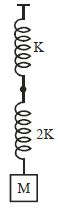
- 8The angular amplitude of a simple pendulum is $\theta_0$. The maximum tension in its string will beView Solution
- 9A particle executes simple harmonic motion with an amplitude of $4 \,cm$. At the mean position the velocity of the particle is $10\, cm/s$. The distance of the particle from the mean position when its speed becomes $5 \,cm/s$ isView Solution
- 10View SolutionTime period of pendulum, on a satellite orbiting the earth, is