A particle is executing the motion $x = A\cos (\omega \,t - \theta )$. The maximum velocity of the particle is
Easy


Download our appand get started for free
Experience the future of education. Simply download our apps or reach out to us for more information. Let's shape the future of learning together!No signup needed.*
Similar Questions
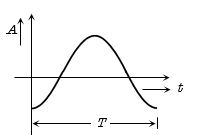
- 1Acceleration $A$ and time period $T$ of a body in $S.H.M.$ is given by a curve shown below. Then corresponding graph, between kinetic energy $(K.E.)$ and time $t$ is correctly represented byView Solution
- 2The $ P.E.$ of a particle executing $SHM$ at a distance $x$ from its equilibrium position isView Solution
- 3Time period of a simple pendulum in a stationary lift is ' $T$ '. If the lift accelerates with $\frac{ g }{6}$ vertically upwards then the time period will be .....View Solution
(where $g =$ acceleration due to gravity)
- 4Let $T_1$ and $T_2$ be the time periods of two springs $A$ and $B$ when a mass $m$ is suspended from them separately. Now both the springs are connected in parallel and same mass $m$ is suspended with them. Now let $T$ be the time period in this position. ThenView Solution
- 5Three simple harmonic motions in the same direction having the same amplitude a and same period are superposed. If each differs in phase from the next by ${45^o}$, thenView Solution
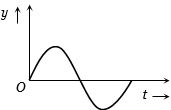
- 6The displacement time graph of a particle executing $S.H.M.$ is as shown in the figureThe corresponding force-time graph of the particle isView Solution
- 7The kinetic energy and potential energy of a particle executing simple harmonic motion will be equal, when displacement (amplitude = $a$) isView Solution
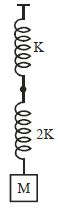
- 8Two springs of force constant $K$ and $2K$ are connected to a mass as shown below. The frequency of oscillation of the mass isView Solution
- 9When a mass $M$ is attached to the spring of force constant $k$, then the spring stretches by $l$. If the mass oscillates with amplitude $l$, what will be maximum potential energy stored in the springView Solution
- 10A light balloon filled with helium of density $\rho_{ He }$ is tied to a long light string of length $l$ and the string is attached to the ground. If the balloon is displaced slightly in the horizontal direction from the equilibrium and released. Then,View Solution