MCQ
There is no hole current in conductors, because they have :
  • A
    High conductivity
  • B
    High electron density
  • C
    No valence band
  • Overlapping of valence and conduction bands.

Answer

Correct option: D.
Overlapping of valence and conduction bands.
In conductors, electrons are loosely bound to the nucleus hence, can detach easily at room temperature. Also, a large number of free electrons thus, available are conduction electrons. When the covalent bond breaks, electrons are freed from the atom.
The departure of an electron from valence band creates the vacancy in bond, this vacancy is known as hole. This hole is captured by another free electron.
Also, the energy level of free electrons corresponds to the conduction level, hence valance level and conduction level are overlapped. So there are no holes in conduction level to carry hole current.
Need a full question paper?

Generate a complete, print-ready paper with questions like this in minutes — across 16+ boards, with answer keys.

Start Generating Free

Similar questions

A charged particle of charge $q$ and mass $m$, gets deflected through an angle $\theta$ upon passing through a square region of side $a$, which contains a uniform magnetic field $B$ normal to its plane. Assuming that the particle entered the square at right angles to one side, what is the speed of the particle?
Light rays from a source are incident on a glass prism of index of refraction $\mu $ and angle of prism $\alpha $. At near normal incidence, the angle of deviation of the emerging rays is
The mean electric energy density between the plates of a charged capacitor is (here q = charge on the capacitor and A = area of the capacitor plate) 
An infinite number of charges, each of charge $1 \,\mu C$ are placed on the $x$-axis with co-ordinates $x = 1, 2,4, 8, ....\infty$. If a charge of $1\, C$ is kept at the origin, then what is the net force acting on $1\, C$ charge....$N$
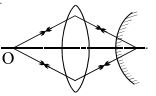
$A$ object is placed at a distance of $15\,cm$ from a convex lens of focal length $10\,cm$. On the other side of the lens, a convex mirror is placed at its focus such that the image formed by the combination coincides with the object itself. The focal length of the convex mirror is.....$cm$
In human eye the focussing is done by
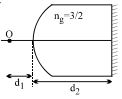
In the figure shown a point object $O$ is placed in air on the principal axis. The radius of curvature of the spherical surface is $60\, cm$. If is the final image formed after all the refractions and reflections.
In a $LCR$ oscillatory circuit find the energy stored in inductor at resonance. If voltage of source is $10 \,V$ and resistance is $10\, \Omega$ and inductance $=1 H$. (in $J$)
The angles of incidence and refraction of a monochromatic ray of light of wavelength $\lambda$ at an air-glass interface are $i$ and $r$, respectively. A parallel beam of light with a small spread $\delta \lambda$ in wavelength about a mean wavelength $\lambda$ is refracted at the same air-glass interface. The refractive index $\mu$ of glass depends on the wavelength $\lambda$ as $\mu(\lambda)=a+b / \lambda^2$, where $a$ and $b$ are constants. Then, the angular spread in the angle of refraction of the beam is
Assertion : A direct current flows through a metallic rod, produced magnetic field only outside the rod.
Reason : There is no flow of charge carriers inside the rod.