Question
Things to keep in mind to get the image formed by the lens.

Answer

→To find the image of an object by a lens, we can, in principal, take any two rays emanating from a point on an object, trace their paths using the laws of refraction and find the point where the refracted rays meet (or appear to meet). In practice, however, it is convenient to choose any two of the following rays:
Image
Image
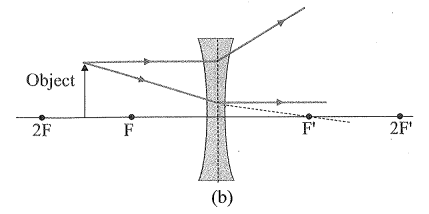
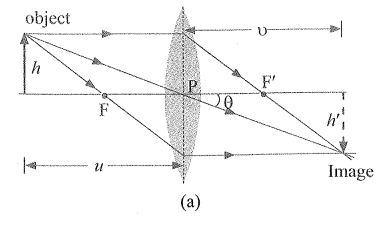
(i) A ray emanating from the object parallel to the principle axis of the lens after refraction passes through the second principal focus (in a convex lens) or appears to diverge (in a concave lens) from the first principal focus.
(ii) A ray of light, passing through the optical centre of the lens, emerges without any deviation after refraction.
(iii) A ray of light passing through the first principal focus of a convex lens (or appearing to meet principal axis at second focus point of a concave lens) emerges parallel to the principal axis after refraction.
→Figure (a) and (b) illustrate these rules for a convex and a concave lens.
Need a full question paper?

Generate a complete, print-ready paper with questions like this in minutes — across 16+ boards, with answer keys.

Start Generating Free

Similar questions

An electron and a proton are brought nearer; how does the potential energy of system change?
Balmer series was observed and analysed before the other series. Can you suggest a reason for such an order?
Net capacitance of three identical capacitors in series is $1\mu\text{F}.$ What will be their net capacitance if connected in parallel?
Find the ratio of energy stored in the two configurations if they are both connected to the same source.
Why potentiometer is more effective instrument in measuring electromotive force of cell than voltmeter?
A block of mass m containing a net positive charge q is placed on a smooth horizontal table which terminates in a vertical wall as shown in figure. The distance of the block from the wall is d. A horizontal electric field E towards right is switched on. Assuming elastic collisions (if any) find the time period of the resulting oscillatory motion. Is it a simple harmonic motion?
What happens to the energy of light waves in interference?
Write the definition of wave front.
Can the potential barrier across a p-n junction be measured by simply connecting a voltmeter across the junction?
The coil of a moving-coil galvanometer keeps on oscillating for a long time if it is deflected and released. If the ends of the coil are connected together, the oscillation stops at once. Explain
A parallel beam of monochromatic light of wavelength 663nm is incident on a totally reflecting plane mirror. The angle of incidence is 60° and the number of photons striking the mirror per second is $1.0 × 10^{19}$. Calculate the force exerted by the light beam on the mirror.