MCQ
Third harmonic frequency in open argonpipe:
  • A
    First overtone
  • Second overtone
  • C
    Third overtone
  • D
    Basic overtone

Answer

Correct option: B.
Second overtone
(B)

Need a full question paper?

Generate a complete, print-ready paper with questions like this in minutes — across 16+ boards, with answer keys.

Start Generating Free

Similar questions

A cubic metal block of mass $5 \,kg$ and edge length $0.1 \,m$ and at an initial temperature of $100^{\circ} C$ is placed on a thermally insulating flat surface and exposed to air at $0^{\circ} C$. The time in seconds required to cool the block to a temperature of $37^{\circ} C$ is closest to

(Note: Specific heat of the metal $=500 \,J / kg /{ }^{\circ} C$; Heat transfer coefficient from block to air $=50 \,W / m ^2 /{ }^{\circ} C$ )
A air bubble rises from bottom of a lake to surface. If its radius increases by $200 \%$ and atmospheric pressure is equal to water coloumn of height $H$. then depth of lake is ..... $H$
If angular velocity of a disc depends an angle rotated $\theta$ as $\omega = \theta ^2 + 2\theta$ , then its angular acceleration $\alpha$ at $\theta = 1$ $rad$ is  ......... $ rad/sec^2$.
Calculate the maximum acceleration (in $m s ^{-2}$) of a moving car so that a body lying on the floor of the car remains stationary. The coefficient of static friction between the body and the floor is $0.15$ $\left( g =10 m s ^{-2}\right)$.
${g_e}$ and ${g_p}$ denote the acceleration due to gravity on the surface of the earth and another planet whose mass and radius are twice as that of earth. Then
One mole of a gas obeying the equation of state $P(V-b)=R T$ is made to expand from a state with coordinates $\left(P_{1}, V_{1}\right)$ to a state with $\left(P_{2}, V_{2}\right)$ along a process that is depicted by a straight line on a $P-V$ diagram. Then, the work done is given by
A ball is projected vertically upward with an initial velocity of $50 \; ms ^{-1}$ at $t =0 \; s$. At $t =2 \,s$. another ball is projected vertically upward with same velocity. At $t= \; \dots \; s$, second ball will meet the first ball $\left( g =10 \; ms ^{-2}\right)$.
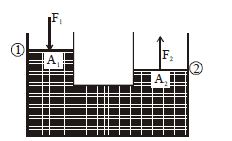
The diagram below shows a hydraulic lift.A force is applied at $side\  1$ and an output force is generated at $side\  2$. Which of the following is true?
A person with his hands in his pockets is skating on ice at the velocity of $10 \,m/s$ and describes a circle of radius $50\, m$. What is his inclination with vertical
Physical independence of force is a consequence of: