This question contains statement$-1$ and statement$-2$. Of the four choices given after the statements, choose the one that best describes the two statements.
statement$-1$ : The temperature dependence of resistance is usually given as $R=R_{0}(1+\alpha \Delta t)$. The resistance of a wire changes from $100\; \Omega$ to $150\; \Omega$ when its temperature is increased from $27^{\circ} C$ to $227^{\circ} C$. This implies that $\alpha=2.5$ $\times 10^{-3} /{ }^{\circ} C$
statement$-2\;: R=R_{0}(1+\alpha \Delta t)$ is valid only when the change in the temperature $\Delta T$ is small and $\Delta R=\left(R-R_{0}\right) < < R_{0}$
AIEEE 2009, Diffcult


Download our appand get started for free
Experience the future of education. Simply download our apps or reach out to us for more information. Let's shape the future of learning together!No signup needed.*
Similar Questions
- 1View SolutionWhen a piece of aluminium wire of finite length is drawn through a series of dies to reduce its diameter to half its original value, its resistance will become ........ times
- 2A carbon resistor of $(47 \pm 4.7) \;k\Omega$ is to be marked with rings of different colours for its identification. The colour code sequence will bView Solution
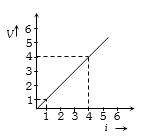
- 3Variation of current and voltage in a conductor has been shown in the diagram below. The resistance of the conductor is. ........... $ohm$View Solution
- 4View SolutionAssertion : Long distance power transmission is done at high voltage.
Reason : At high voltage supply power losses are less.
- 5Two wires $A$ and $B $ of same material and same mass have radius $2r$ and $r$ . If resistance of wire $A$ is $34\,\Omega $, then resistance of $B$ will be ............ $\Omega$View Solution
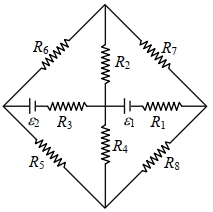
- 6The figure shows a circuit having eight resistances of $1 \Omega$ each, labelled $R_1$ to $R_8$, and two ideal batteries with voltages $\varepsilon_1=12 V$ and $\varepsilon_2=6 V$.View Solution
Which of the following statement($s$) is(are) correct?
$(A)$ The magnitude of current flowing through $R_1$ is $7.2 A$.
$(B)$ The magnitude of current flowing through $R_2$ is $1.2 A$.
$(C)$ The magnitude of current flowing through $R_3$ is $4.8 A$.
$(D)$ The magnitude of current flowing through $R_5$ is $2.4 A$.
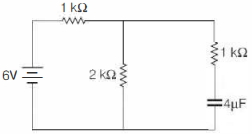
- 7The circuit shown has been connected for a long time. The voltage across the capacitor is ............. $V$View Solution
- 8View SolutionIf an electric current is passed through a nerve of a man, then man
- 9Two uniform wires $A$ and $B$ are of the same metal and have equal masses. The radius of wire $A$ is twice that of wire $B$. The total resistance of A and $B$ when connected in parallel isView Solution
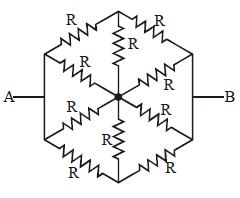
- 10Find out equivalent resistance between $A$ and $B$View Solution