MCQ
This question contains statement$-1$ and statement$-2$. Of the four choices given after the statements, choose the one that best describes the two statements.

statement$-1$ : The temperature dependence of resistance is usually given as $R=R_{0}(1+\alpha \Delta t)$. The resistance of a wire changes from $100\; \Omega$ to $150\; \Omega$ when its temperature is increased from $27^{\circ} C$ to $227^{\circ} C$. This implies that $\alpha=2.5$ $\times 10^{-3} /{ }^{\circ} C$

statement$-2\;: R=R_{0}(1+\alpha \Delta t)$ is valid only when the change in the temperature $\Delta T$ is small and $\Delta R=\left(R-R_{0}\right) < < R_{0}$

  • Statement $-1$ is true, statement $-2$ is false
  • B
    Statement $-1$ is true, statement $-2$ is true; statement $-2$ is the correct explanation of Statement $-1$
  • C
    Statement $-1$ is true, statement $-2$ is true; statement $-2$ is not the correct explanation of Statement $-1$
  • D
    Statement $-1$ is false, statement $-2$ is true
Answer

Correct option: A.
Statement $-1$ is true, statement $-2$ is false
a
$R =150 ; R _{0}=100$ and $\Delta t =227^{\circ} C -27^{\circ} C =200^{\circ} C$

$R = R _{0}(1+\alpha \Delta t )$

$150=100(1+\alpha(200))$

$\therefore \alpha=2.5 \times 10^{-3} /{ }^{\circ} C$

for $\Delta R =150-100=50$ , $R - R _{0}<< R _{0}$ cannot say .

Statement $-2$ is false

Need a full question paper?

Generate a complete, print-ready paper with questions like this in minutes — across 16+ boards, with answer keys.

Start Generating Free

Similar questions

In the disintegration series the $_{92}^{238}U\xrightarrow{\alpha }X\xrightarrow{{\beta  - }}_Z^AY$ values of $Z$ and $A$ respectively will be
At any instant, two elements $X _1$ and $X _2$ have same number of radioactive atoms. If the decay constant of $X _1$ and $X _2$ are $10 \lambda$ and $\lambda$ respectively. then the time when the ratio of their atoms becomes $\frac{1}{e}$ respectively will be
The magnetic field of a plane electromagnetic wave is given by $\overrightarrow{ B }=3 \times 10^{-8} \cos \left(1.6 \times 10^3 x +48 \times 10^{10} t \right) \hat{ j }$, then the associated electric field will be :
An electric dipole is placed on ${x}$-axis in proximity to a line charge of linear charge density $3.0 \times 10^{-6}\, {C} / {m}$. Line charge is placed on $z-$axis and positive and negative charge of dipole is at a distance of $10\, {mm}$ and $12\, {mm}$ from the origin respectively. If total force of $4\, {N}$ is exerted on the dipole, find out the amount of positive or negative charge of the dipole.
A $10\, m$ long wire of $20\,\Omega$ resistance is connected with a battery of $3\, volt$ $e.m.f.$ (negligible internal resistance) and a $10 \,\Omega$ resistance is joined to it is series. Potential gradient along wire in volt per meter is
If instantaneous current is given by $i = 4\cos \,(\omega \,t + \phi )$ amperes, then the $r.m.s$. value of current is
Choose the incorrect statement :

$(a)$ The electric lines of force entering into a Gaussian surface provide negative flux.

$(b)$ A charge ' $q$ ' is placed at the centre of a cube. The flux through all the faces will be the same.

$(c)$ In a uniform electric field net flux through a closed Gaussian surface containing no net charge, is zero.

$(d)$ When electric field is parallel to a Gaussian surface, it provides a finite non-zero flux.

Choose the most appropriate answer from the options given below

In a vibration magnetometer, the time period of a bar magnet oscillating in horizontal component of earth's magnetic field is $2$ $sec$. When a magnet is brought near and parallel to it, the time period reduces to $1 $ $sec$. The ratio $H/F $ of the horizontal component $H$  and the field $F$ due to magnet will be
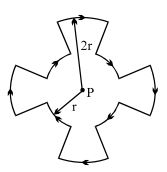
A current $I$ flows around a closed path in the horizontal plane of the circle as shown in the figure. The path consists of eight arcs with alternating radii $r$ and $2r$. Each segment of arc subtends equal angle at the common centre $P.$ The magnetic field produced by current path at point $P$ is
Which of the following is used in the Davisson $–$ Germer experiment?