MCQ
This question has Statement $1$ and Statement $2$. Of the four choices given after the Statements, choose the one that best describes the two Statements.
Statement $1$ : When moment of inertia $I$ of a body rotating about an axis with angular speed $\omega $ increases, its angular momentum $L$ is unchanged but the kinetic energy $K$ increases if there is no torque applied on it.
Statement $2$ : $L = I\omega $, kinetic energy of rotation $ = \frac{1}{2}\,I\omega ^2$
  • A
    Statement $1$ is true, Statement $2$ is true,
    Statement $2$ is not the correct explanation of Statement $1$
  • Statement $1$ is false, Statement $2$ is true.
  • C
    Statement $1$ is true, Statement $2$ is true,
    Statement $2$ is correct explanation of the Statement $1$ 
  • D
    Statement $1$ is true, Statement $2$ is false
Answer

Correct option: B.
Statement $1$ is false, Statement $2$ is true.
b
AS $L\, = I\omega $ so L increases with increase in $\omega $.

Kinetic $energ{y_{\left( {rotational} \right)}}$ depends on an angular velocity $'\omega '$

and moment of inertia of the body I.

i.e., $K.E{._{\left( {rotational} \right)}} = \frac{1}{2}I{\omega ^2}$

Need a full question paper?

Generate a complete, print-ready paper with questions like this in minutes — across 16+ boards, with answer keys.

Start Generating Free

Similar questions

Two particles of equal masses are moving with equal speed on circular paths of radii $r_1$ and $r_2$. The ratio of their centripetal forces will be
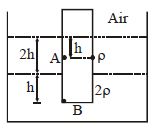
A cylinder stands vertical in two immiscible liquids of densities $\rho$ and $2 \rho$. The height of two liquids are shown. Find the difference in pressure at point $A$ and $B$
Let $V$ and $E$ denote the gravitational potential and gravitational field at a point. It is possible to have:
  1. $V = 0$ and $E = 0$
  2. $V = 0$ and $E \neq 0$
  3. $V \neq 0$ and $E = 0$
  4. $V \neq 0$ and $E \neq 0$
When a rubber ball is taken to a depth of $......\,{m}$ in deep sea, its volume decreases by $0.5\, \%$

(The bulk modulus of rubber $=9.8 \times 10^{8}\, {Nm}^{-2}$ Density of sea water $=10^{3} {kgm}^{-3}$

$\left.{g}=9.8\, {m} / {s}^{2}\right)$

Dimension of electric current is
The work done on a particle of mass $m$ by a force, $k\left[\frac{x}{\left(x^2+y^2\right)^{3 / 2}} \hat{i}+\frac{y}{\left(x^2+y^2\right)^{3 / 2}} \hat{j}\right]$ ( $K$ being a constant of appropriate dimensions), when the particle is taken from the point $(a, 0)$ to the point $(0, a )$ along a circular path of radius a about the origin in the $x$-y plane is :
The distance travelled by an object in time $t$ is given by $s =(2 \cdot 5) t ^2$. The instantaneous speed of the object at $t =5\,s$ will be $....\,ms ^{-1}$
A body is dropped from a satellite in parking orbit. Which of the following describes its behaviour correctly?
$A$ rod is hinged at its centre and rotated by applying a constant torque starting from rest. The power developed by the external torque as a function of time is :
The disturbance $y (x, t)$ of a wave propagating in the positive. $x-$ direction is given by $y = \frac{1}{{1 + {x^2}}}$ at time $t\,= 0$ and by $y = \frac{1}{{\left[ {1 + {{\left( {x - 1} \right)}^2}} \right]}}$ at $t\, = 2\, s$, where $x$ and $y$ are in meters. The shape of the wave disturbance does not change during the propagation. The velocity of wave in $m/s$ is