Question
This symbol represents
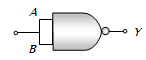
|
(a) NOT gate |
(b) OR gate |
(c) AND gate |
(d) NOR gate |
This symbol represents
|
(a) NOT gate |
(b) OR gate |
(c) AND gate |
(d) NOR gate |
(a) NOT gate
Generate a complete, print-ready paper with questions like this in minutes — across 16+ boards, with answer keys.
The dominant mechanisms for motion of charge carriers in forward and reverse biased silicon P-N junctions are
|
(a) Drift in forward bias, diffusion in reverse bias |
|
(b) Diffusion in forward bias, drift in reverse bias |
|
(c) Diffusion in both forward and reverse bias |
|
(d) Drift in both forward and reverse bias |
In a diode AM-detector, the output circuit consist of R = 1kW and C = 10 pF. A carrier signal of 100 kHz is to be detected. Is it good
|
(a) Yes |
(b) No |
|
(c) Information is not sufficient |
(d) None of these |
The current flowing in a coil of self inductance 0.4 mH is increased by 250 mA in 0.1 sec. The e.m.f. induced will be
|
(a) + 1 V |
(b) – 1 V |
(c) + 1 mV |
(d) – 1 mV |
$\text{x}=\text{A}\sin(\text{ky}-\omega\text{t})$
$\text{y}=\text{A}\sin(\text{kx}-\omega\text{t})$
$\text{y}=\text{A}\sin\text{ky}\cos\ \omega\text{t}$
$\text{y}=\text{A}\cos\text{ky}\sin\ \omega\text{t}.$