MCQ
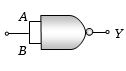
This symbol represents
  • $NOT$ gate
  • B
    $OR$ gate
  • C
    $AND$ gate
  • D
    $NOR$ gate

Answer

Correct option: A.
$NOT$ gate
a
(a)

Need a full question paper?

Generate a complete, print-ready paper with questions like this in minutes — across 16+ boards, with answer keys.
Start Generating Free

Similar questions

A $p-n$ photodiode is made of a material with a band gap of $2.0\, eV.$ The minimum frequency of the radiation that can be absorbed by the material is nearly 
A solid conducting sphere having a charge Q is surrounded by an uncharged concentric conducting hollow spherical shell. Let the potential difference between the surface of the solid sphere and that of the outer surface of the hollow shell be V. If the shell is now given a charge of –3Q, the new potential difference between the same two surfaces is
The operation of a nuclear reactor is said to be critical, if the multiplication factor $(K)$ has a value
Which of the following figure represents the variation of particle momentum and the associated de-Broglie wavelength
In a semiconductor the separation between conduction band and valence band is of the order of.....$eV$
A charged particle enters a uniform magnetic field with velocity vector making an angle of $30^o$ with the magnetic field. The particle describes a helical trajectory of pitch $x$ . The radius of the helix is
Assume you are sitting in sun for $2.5$ hours. The area of your body exposed normally to sun rays $1.3 m^2$. The intensity of sun rays is $\frac{1.1 \text { Kilowatt }}{ m ^2}$ If your body completely absorbs the sun rays then the momentum transferred to your body will be $($in $Kg -\frac{ m }{ s } ):$
A house is served by $220\, V$ supply line in a circuit protected by a $9\, ampere$ fuse. The maximum number of $60\, W$ lamps in parallel that can be turned on, is
Three capacitors of capacitances $3\,\mu F,\;9\,\mu F$ and $18\,\mu F$ are connected once in series and another time in parallel. The ratio of equivalent capacitance in the two cases $\left( {\frac{{{C_s}}}{{{C_p}}}} \right)$ will be
The angular dispersion produced by a prism: