Question
Though a woman can see the distant object clearly, she cannot see the nearby objects clearly. She is suffering from the defect of vision called:
  1. Long-sight.
  2. Short-sight.
  3. Hind-sight.
  4. Mid-sight.

Answer

  1. Long sight.

Explanation:

As the woman can see distant objects clearly, but not nearby objects, she is suffering from the defect of vision called long sight.

Need a full question paper?

Generate a complete, print-ready paper with questions like this in minutes — across 16+ boards, with answer keys.

Start Generating Free

Similar questions

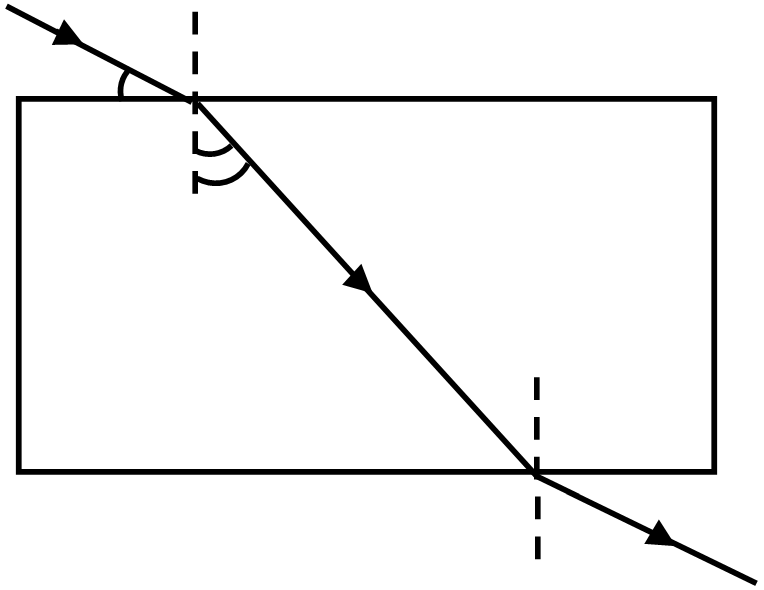
A student traces the path of a ray of white light through a rectangular glass slab and marks, the angles of incidence $(\angle \text{ i})$, refraction (r) and emergence (e) as shown.
Variable focal length of eye is responsible for:
He then measures the corresponding values of the angle of $(\angle\text{i}).$A student very cautiously traces the path of a ray through a glass slab for different values of the angle of incidence refraction $(\angle\text{r}).$ and the angle of emergence $(\angle\text{e}).$ for every value of the angle of incidence. On analysing these measurements of angles, his conclusion would be.
Magnification produced by a concave lens is always:
  1. More than 1.
  2. Equal to 1.
  3. Less than 1.
  4. More than 1 or less than 1.
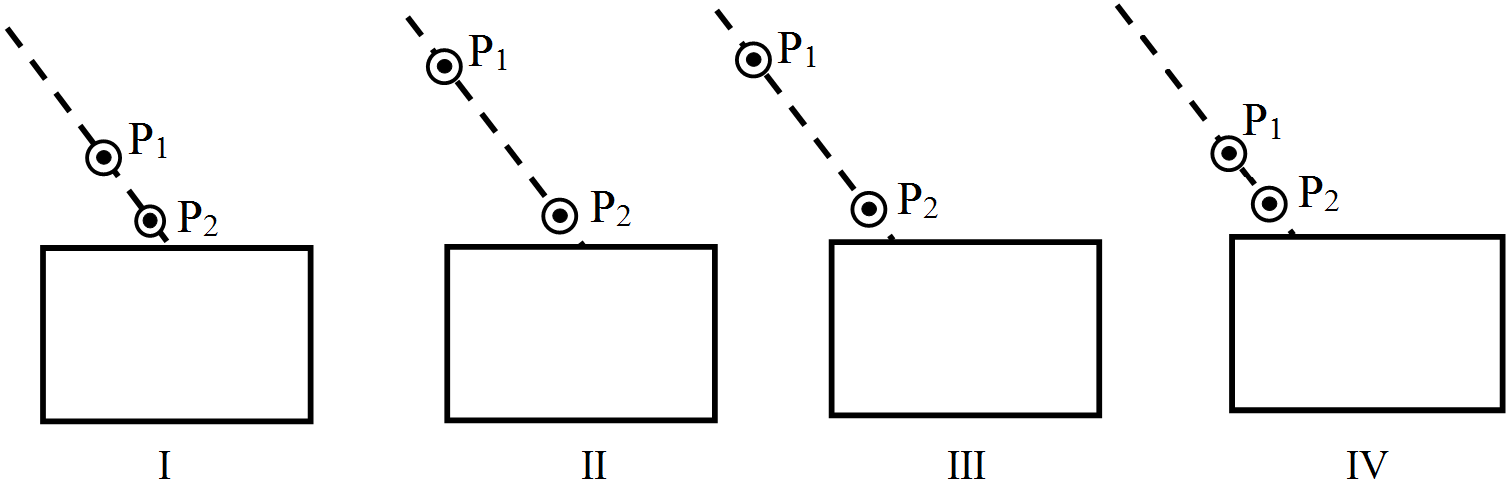
Four students showed the following traces of the path of a ray of light passing through a rectangular glass slab.

The trace most likely to be correct is that of student:
With age Near point and Far point receeds due to:
A: Weakening of ciliary muscles.
B: Reducing ability to change the focal length.
When the area of cross-section of a conductor is doubled, its resistance becomes:
  1. Double.
  2. Half.
  3. Four time.
  4. One-fourth.
A magnetic field exerts no force on:
  1. An electrical charge moving perpendicular to its direction...
  2. An unmagnetised iron bar.
  3. A stationary electric charge.
  4. A magnet.
Rays from Sun converge at a point 15cm in front of a concave mirror. Where should an object be placed so that size of its image is equal to the size of the object?
  1. 15cm in front of the mirror.
  2. 30cm in front of the mirror.
  3. Between 15cm and 30cm in front of the mirror.
  4. More than 30cm in front of the mirror.