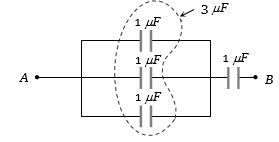
Three capacitors each of capacitance $1\,\mu F$ are connected in parallel. To this combination, a fourth capacitor of capacitance $1\,\mu F$ is connected in series. The resultant capacitance of the system is.......$\mu F$
  • A$4$
  • B$2$
  • C$1.33$
  • D$0.75$
Medium
art

Download our app
and get started for free

Experience the future of education. Simply download our apps or reach out to us for more information. Let's shape the future of learning together!No signup needed.*

Similar Questions

  • 1
    A capacitor has air as dielectric medium and two conducting plates of area $12 \mathrm{~cm}^2$ and they are $0.6 \mathrm{~cm}$ apart. When a slab of dielectric having area $12 \mathrm{~cm}^2$ and $0.6 \mathrm{~cm}$ thickness is inserted between the plates, one of the conducting plates has to be moved by $0.2 \mathrm{~cm}$ to keep the capacitance same as in previous case. The dielectric constant of the slab is : (Given $\left.\epsilon_0=8.834 \times 10^{-12} \mathrm{~F} / \mathrm{m}\right)$
    View Solution
  • 2
    A $10\,\mu F$ capacitor is charged to a potential difference of $1000\, V$. The terminals of the charged capacitor are disconnected from the power supply and connected to the terminals of an uncharged $6\, \mu F$ capacitor. What is the final potential difference across each capacitor?......$V$
    View Solution
  • 3
    Two capacitors $A$ and $B$ are connected in series with a battery as shown in the figure. When the switch $S$ is closed and the two capacitors get charged fully, then
    View Solution
  • 4
    Charges are placed on the vertices of a square as shown Let $\vec E$ be the electric field and $V$ the potential at the centre. If the charges on $A$ and $B$ are interchanged with those on $D$ and $C$ respectively, then
    View Solution
  • 5
    A particle $A$ has charge $ + q$ and a particle $B$ has charge $ + \,4q$ with each of them having the same mass $m$. When allowed to fall from rest through the same electric potential difference, the ratio of their speed $\frac{{{v_A}}}{{{v_B}}}$ will become
    View Solution
  • 6
    In an insulated parallel-plate capacitor of capacitance $C$, the four surfaces have charges $Q_1, Q_2, Q_3$ and $Q_4$ as shown. The potential difference between the plate is
    View Solution
  • 7
    $STATEMENT-1$ For practical purposes, the earth is used as a reference at zero potential in electrical circuits.and

    $STATEMENT-2$ The electrical potential of a sphere of radius $R$ with charge $\mathrm{Q}$ uniformly distributed on the surface is given by $\frac{\mathrm{Q}}{4 \pi \varepsilon_0 R}$.

    View Solution
  • 8
    The potential (in volts ) of a charge distribution is given by

    $V(z)\, = \,30 - 5{z^2}for\,\left| z \right| \le 1\,m$

    $V(z)\, = \,35 - 10\,\left| z \right|for\,\left| z \right| \ge 1\,m$

    $V(z)$  does not depend on $x$  and  $y.$  If this potential is generated by a constant charge per unit volume $\rho _0$ (in units of $\varepsilon _0$ ) which is spread over a certain region, then choose the correct statement

    View Solution
  • 9
    Charges $Q, 2Q$ and $-Q$ are given to three concentric conducting shells $A, B$ and $C$ respectively as shown the ratio of charges on inner and outer surfaces of shell $C$ will be
    View Solution
  • 10
    Electric charges of $+10\,\mu\, C, +5\,\mu\, C, -3\,\mu\, C$ and $+8\,\mu\, C$ are placed at the corners of a square of side$\sqrt 2\,m$ . The potential at the centre of the square is
    View Solution