The maximum energy in the thermal radiation from a hot source occurs at a wavelength of $11 \times {10^{ - 5}}cm$. According to Wein's law, the temperature of the source (on Kelvin scale) will be $n$ times the temperature of another source (on Kelvin scale) for which the wavelength at maximum energy is $5.5 \times {10^{ - 5}}cm$. The value $n$ is
Medium
Download our app for free and get started
(c)$\frac{{{T_1}}}{{{T_2}}} = \frac{{{\lambda _{{m_2}}}}}{{{\lambda _{{m_1}}}}} = \frac{{5.5 \times {{10}^5}}}{{11 \times {{10}^5}}} = \frac{1}{2}$
==>$n = 2$

Download our appand get started for free
Experience the future of education. Simply download our apps or reach out to us for more information. Let's shape the future of learning together!No signup needed.*
Similar Questions
- 1The heat is flowing through a rod of length $50 cm$ and area of cross-section $5c{m^2}$. Its ends are respectively at ${25^o}C$ and ${125^o}C$. The coefficient of thermal conductivity of the material of the rod is $0.092 kcal/m×s×^\circ C$. The temperature gradient in the rod isView Solution
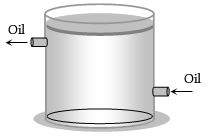
- 2The top of insulated cylindrical container is covered by a disc having emissivity $0.6$ and thickness $1\, cm$. The temperature is maintained by circulating oil as shown in figure. If temperature of upper surface of disc is $127^o C$ and temperature of surrounding is $27^o C$, then the radiation loss to the surroundings will be (Take $\sigma = \frac{{17}}{3} \times {10^{ - 8}}W/{m^2}{K^4})$View Solution
- 3Two rods having thermal conductivity in the ratio of $5 : 3$ having equal lengths and equal cross-sectional area are joined by face to face. If the temperature of the free end of the first rod is $100°C$ and free end of the second rod is $20°C$ . Then temperature of the junction is...... $^oC$View Solution
- 4A beaker full of hot water is kept in a room. If it cools from $80^{\circ} C$ to $75^{\circ} C$ in $t_1$, minutes, from $75^{\circ} C$ to $70^{\circ} C$ in $t_2$ minutes and from $70^{\circ} C$ to $65^{\circ} C$ in $t_3$ minutes, thenView Solution
- 5The 'Kangri' is an earthen pot used to stay warm in Kashmir during the winter months. Assume that the 'Kangri' is spherical and of surface area $7 \times 10^{-2} \,m ^{2}$. It contains $300 g$ of a mixture of coal, wood and leaves with calorific value of $30 \,kJ / g$ (and provides heat with $10 \%$ efficiency). The surface temperature of the 'Kangri' is $60^{\circ} C$ and the room temperature is $0^{\circ} C$. Then, a reasonable estimate for the duration $t$ (in h) that the 'Kangri' heat will last is (take the 'Kangri' to be a black body)View Solution
- 6Two rods one made of copper and other made of steel of the same length and same cross sectional area are joined together. The thermal conductivity of copper and steel are $385\,J\,s ^{-1}\,K ^{-1}\,m ^{-1}$ and $50\,J\,s ^{-1}\,K ^{-1}\,m ^{-1}$ respectively. The free ends of copper and steel are held at $100^{\circ}\,C$ and $0^{\circ}\,C$ respectively. The temperature at the junction is, nearly $.......^{\circ}\,C$View Solution
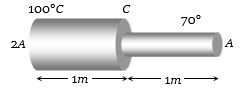
- 7$A$ metal rod of length $2$$m$ has cross sectional areas $2A$ and $A$ as shown in figure. The ends are maintained at temperatures $100°C$ and $70°C$ . The temperature at middle point $C$ is...... $^oC$View Solution
- 8If temperature of sun is decreased by $1 \%$ then the value of solar constant will change by ........... $\%$View Solution
- 9rod of $40\, cm$ in length and temperature difference of ${80^o}C$ at its two ends. $A$ nother rod $B$ of length $60\, cm$ and of temperature difference ${90^o}C$, having the same area of cross-section. If the rate of flow of heat is the same, then the ratio of their thermal conductivities will beView Solution
- 10View SolutionAbsorption co-efficient of an open window is...