Three capacitors of capacitance $3\,\mu \,F$ are connected in a circuit. Then their maximum and minimum capacitances will be
Easy


Download our appand get started for free
Experience the future of education. Simply download our apps or reach out to us for more information. Let's shape the future of learning together!No signup needed.*
Similar Questions
- 1Two point charges $4\,\mu C$ and $ - 1\,\mu C$ are kept at a distance of $3\ m$ from each other. What is the electric potential at the point where the electric field is zero?......$V$View Solution
- 2View SolutionThe capacity of a parallel plate capacitor increases with the
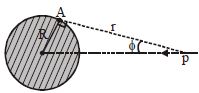
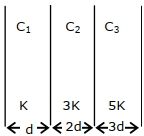
- 3In the reported figure, a capacitor is formed by placing a compound dielectric between the plates of parallel plate capacitor. The expression for the capacity of the said capacitor will be (Given area of plate $=A$ )View Solution
- 4Charges of $ + \frac{{10}}{3} \times {10^{ - 9}}C$ are placed at each of the four corners of a square of side $8\,cm$. The potential at the intersection of the diagonals isView Solution
- 5A charge of $5\,C$ is given a displacement of $0.5\,m$. The work done in the process is $10\,J$. The potential difference between the two points will be.......$V$View Solution
- 6In a uniform electric field, a cube of side $1\ cm$ is placed. The total energy stored in the cube is $8.85\mu J$ . The electric field is parallel to four of the faces of the cube. The electric flux through any one of the remaining two faces is.View Solution
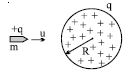
- 7A bullet of mass $m$ and charge $q$ is fired towards a solid uniformly charged sphere of radius $R$ and total charge $+ q$. If it strikes the surface of sphere with speed $u$, find the minimum speed $u$ so that it can penetrate through the sphere. (Neglect all resistance forces or friction acting on bullet except electrostatic forces)View Solution
- 8An electron enters between two horizontal plates separated by $2\,mm$ and having a potential difference of $1000\,V$. The force on electron isView Solution
- 9View SolutionA long, hollow conducting cylinder is kept coaxially inside another long, hollow conducting cylinder of larger radius. Both the cylinders are initially electrically neutral.
- 10A dipole having dipole moment $p$ is placed in front of a solid uncharged conducting sphere as shown in the diagram. The net potential at point $A$ lying on the surface of the sphere is :-View Solution