A charge of $5\,C$ is given a displacement of $0.5\,m$. The work done in the process is $10\,J$. The potential difference between the two points will be.......$V$
Easy
Download our app for free and get started
(a) Since $W = qV$ $==>$ $20 = 5 × V$
$V = 2\, volts$

Download our appand get started for free
Experience the future of education. Simply download our apps or reach out to us for more information. Let's shape the future of learning together!No signup needed.*
Similar Questions
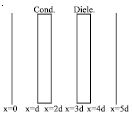
- 1The distance between plates of a parallel plate capacitor is $5d$. Let the positively charged plate is at $ x=0$ and negatively charged plate is at $x=5d$. Two slabs one of conductor and other of a dielectric of equal thickness $d$ are inserted between the plates as shown in figure. Potential versus distance graph will look like :View Solution
- 2The area of each plate of a parallel plate capacitor is $100\,c{m^2}$and the distance between the plates is $1\,mm$. It is filled with mica of dielectric $6$. The radius of the equivalent capacity of the sphere will be.......$m$View Solution
- 3Consider a sphere of radius $R$ with uniform charge density and total charge $Q$. The electrostatic potential distribution inside the sphere is given by $\theta_{(r)}=\frac{Q}{4 \pi \varepsilon_{0} R}\left(a+b(r / R)^{C}\right)$. Note that the zero of potential is at infinity. The values of $(a, b, c)$ areView Solution
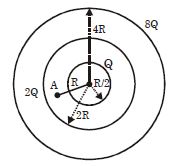
- 4Three charged concentric nonconducting shells are given as shown in figure. Find the potential at point $A$View Solution
- 5View SolutionThe capacity of a parallel plate capacitor increases with the
- 6$125$ identical drops each charged to the same potential of $50\;volts$ are combined to form a single drop. The potential of the new drop will be......$V$View Solution
- 7If there are $n$ capacitors in parallel connected to $V$ volt source, then the energy stored is equal toView Solution
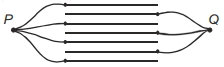
- 8Seven identical plates each of area $A$ and successive separation $d$ are arranged as shown in figures. The effective capacitance of the system between $P$ and $Q$ isView Solution
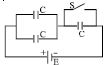
- 9In the circuit shown, each capacitor has a capacitance $C$. The emf of the cell is $E$. If the switch $S$ is closedView Solution
- 10A $10\,\mu F$ capacitor is charged to a potential difference of $50\;V$ and is connected to another uncharged capacitor in parallel. Now the common potential difference becomes $20\;volt$. The capacitance of second capacitor is....$\mu F$View Solution