MCQ
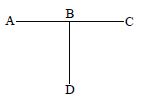
Three conducting rods of same material and cross section are shown in figure. Temperature at $A,D$ and $C$ are maintained at $20\ ^oC, 90\ ^oC$ and $0\ ^oC$. The ratio of lengths of $BD$ and $BC$ if there is no heat. Flows in $AB$ is
  • A
    $\frac{2}{7}$
  • $3.5$
  • C
    $4.5$
  • D
    $\frac{2}{9}$

Answer

Correct option: B.
$3.5$
b

Need a full question paper?

Generate a complete, print-ready paper with questions like this in minutes — across 16+ boards, with answer keys.

Start Generating Free

Similar questions

Given below are two statements :

Statement $(I)$ : Dimensions of specific heat is $\left[\mathrm{L}^2 \mathrm{~T}^{-2} \mathrm{~K}^{-1}\right]$

Statement $(II)$ : Dimensions of gas constant is $\left[\mathrm{ML}^2 \mathrm{~T}^{-1} \mathrm{~K}^{-1}\right]$

Let a wave $\text{y(x, t)}=\text{a}\sin(\text{kx}-\omega\text{t})$ is reflected from an open boundary and then the incident and reflected waves overlaps. Then the amplitude of resultant wave:
Suppose that the angular velocity of rotation of earth is increased. Then, as a consequence.
The ratio of the lengths of two wires $A$ and $B$ of same material is $1 : 2$ and the ratio of their diameter is $2 : 1.$ They are stretched by the same force, then the ratio of increase in length will be
Two vectors having equal magnitudes of $x\, units$ acting at an angle of $45^o$ have resultant $\sqrt {\left( {2 + \sqrt 2 } \right)} $ $units$. The value of $x$ is
A motor cyclist going round in a circular track at constant speed has
The heavier nuclei tend to have larger $\frac{\text{N}}{\text{Z}}$ ratio because:
  1. A neutron is heavier than a proton.
  2. A neutron is an unstable particle.
  3. A neutron does not exert electric repulsion.
  4. Coulomb forces have longer range compared to the nuclear forces.
$Ampere - hour$ is a unit of
The value of escape velocity on a certain planet is $2\, km/s$. Then the value of orbital speed for a satellite orbiting close to its surface is
Two rods of different materials having coefficients of linear expansion ${\alpha _1},\,{\alpha _2}$ and Young's moduli ${Y_1}$ and ${Y_2}$ respectively are fixed between two rigid massive walls. The rods are heated such that they undergo the same increase in temperature. There is no bending of rods. If ${\alpha _1}:{\alpha _2} = 2:3$, the thermal stresses developed in the two rods are equally provided ${Y_1}:{Y_2}$ is equal to