Question
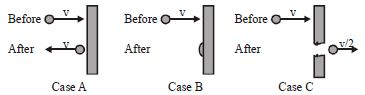
Three different projectiles, each with the same mass, are fired with speed $v$ at a wall. In case $A,$ the projectile bounces straight back with speed $v.$ In case $B$, the projectile sticks to the wall. In case $C$, the projectile crashes through the wall and emerges with half its original speed. These three cases are shown here.

Place the impulse exerted by the wall on the projectile in each of these three cases in the correct order.
Answer

$\vec {\mathrm{I}}_{\mathrm{aup}}=\vec {\mathrm{p}}_{\mathrm{f}}-\vec {\mathrm{p}}_{\mathrm{i}}$

(1) $\mathrm{I}_{\mathrm{mp}}=2 \mathrm{mv} \leftarrow$

(2) $\mathrm{I}_{\mathrm{mp}}=\mathrm{mv} \leftarrow$

(3) $\mathrm{I}_{\mathrm{mp}}=\frac{\mathrm{mv}}{2} \leftarrow$

Need a full question paper?

Generate a complete, print-ready paper with questions like this in minutes — across 16+ boards, with answer keys.

Start Generating Free

Similar questions

A tuning fork of frequency $340Hz$ is vibrated just above the tube of $120 cm$ height. Water is poured slowly in the tube. What is the minimum height of water necessary for the resonance .... $cm$ (speed of sound in the air $= 340 m/sec$)
A stone is thrown vertically upward with an initial velocity $v_0$. The distance travelled in time $\frac{1.5\,v_0}{g}$ is
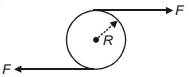
Two equal and opposite forces are applied tangentially to a uniform disc of mass $M$ and radius $R$ as shown in the figure. If the disc is pivoted at its centre and free to rotate in its plane, the angular acceleration of the disc is ............
Which of the following quantities does not depend upon the orbital radius of the satellite.
A cylindrical copper rod has length $L$ and resistance $R$. If it is melted and formed into another rod of length $2 L$, then the resistance will be ....... $R$
To explain his theory, Bohr used
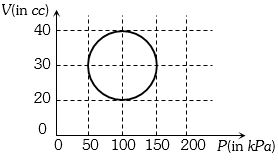
A system is taken through a cyclic process represented by a circle as shown. The heat absorbed by the system is
The photograph of a house occupies an area of $1.75\; cm^2$ on a $35\; mm$ slide. The slide is projected on to a screen, and the area of the house on the screen is $1.55\; m^2$. What is the linear magnification of the projector-screen arrangement
Two satellites of mass $50\,kg$ and $100\,kg$ revolve around the earth in circular orbit of radius $9\,R$ and $16\,R$ respectively, where $R$ is the radius of earth. The speeds of the two satellites will be in the ratio
The amplification produced by a triode is due to the action of