Question
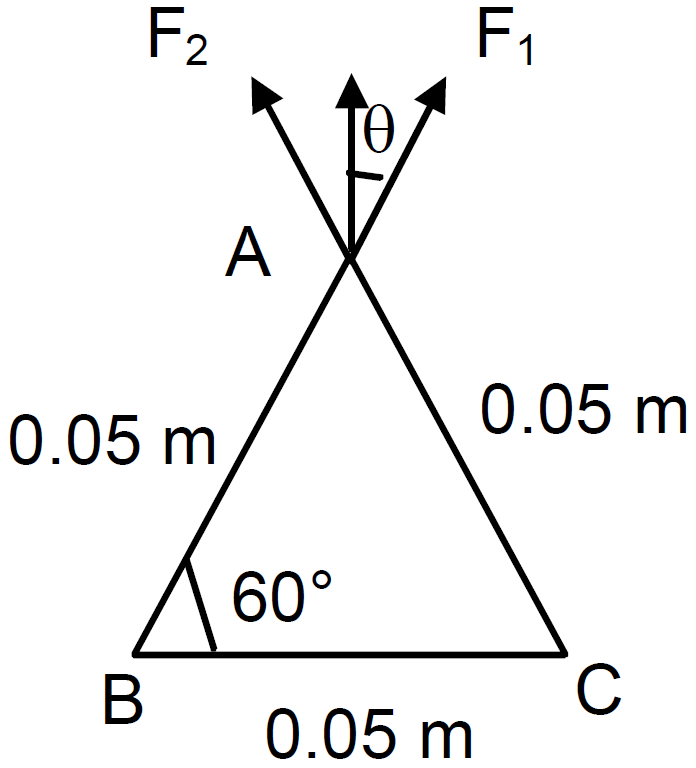
Three equal charges, $2.0 \times 10^{-6}C$ each, are held fixed at the three corners of an equilateral triangle of side 5cm. Find the Coulomb force experienced by one of the charges due to the rest two.
Answer


Three charges are held at three corners of a equilateral trangle.
Let the charges be A, B and C.
It is of length 5cm or 0.05m
Force exerted by B on A $= F_1$
Force exerted by C on A $= F_2$
So, force exerted on A = resultant $F_1 = F_2$
$\Rightarrow\text{F}=\frac{\text{kq}_2}{\text{r}^2}$
$=\frac{9\times10^9\times2\times2\times2\times10^{-12}}{5\times5\times10^{-4}}$
$=\frac{36}{25}\times10$
$=14.4$
Now, force on $A = 2 × F$ cos $30^\circ$ since it is equilateral $\triangle.$
$⇒ $Force on $\text{A}=2\times1.44\times\sqrt{\frac{3}{2}}$
$=24.94\text{N}.$

Need a full question paper?

Generate a complete, print-ready paper with questions like this in minutes — across 16+ boards, with answer keys.
Start Generating Free

Similar questions

An inductor 200mH, a capacitor $100\mu\text{F}$ and a resistor $10\Omega$ are connected in series to an a.c. source of 100V, having variable frequency.
  1. At what frequency of the applied voltage will the power factor of the circuit be 1?
  2. What will be the current amplitude at this frequency?
  3. Calculate the Q-factor of the circuit.
A light ray is incident at an angle of 45° with the normal to a $\sqrt{2}\text{cm}$ thick plate $(\mu = 2.0)$. Find the shift in the path of the light as it emerges out from the plate.
Suppose a monochromatic X-ray beam of wavelength 100pm is sent through a Young's double slit and the interference pattern is observed on a photographic plate placed 40cm away from the slit. What should be the separation between the slits so that the successive maxima on the screen are separated by a distance of 0.1mm?
Calculate the tension in the string shown in figure. The pulley and the string are light and all surfaces are frictionless. Take $g = 10m/s^2.$
A point object is placed on the principal axis of a convex lens (f = 15cm) at a distance of 30cm from it. A glass plate $(\mu=1.50)$ of thickness 1cm is placed on the other side of the lens perpendicular to the axis. Locate the image of the point object.
A current of 5.0A exists in the circuit shown in the figure. The wire PQ has a length of 50cm and the magnetic field in which it is immersed has a magnitude of 0.20T. Find the magnetic force acting on the wire PQ.
A particle of mass m moves on a straight line with its velocity varying with the distance travelled according to the equation $\text{v}=\text{a}\sqrt{\text{x}},$ where a is a constant. Find the total work done by all the forces during a displacement from x = 0 to x = d.

The energy levels of a hypothetical atom are shown below. Which of the shown transitions will result in the emission of a photon of wavelength 275 nm?
Which of these transitions correspond to emission of radiation of (i) maximum and (ii) minimum wavelength?
A particle of mass ‘m’, with charge ‘q’ moving with a uniform speed ‘v’, normal to a uniform magnetic field ‘B’, describes a circular path of radius ‘r’. Derive expressions for the:
  1. Time period of revolution.
  2. Kinetic energy of the particle.
The speed of sound in air is 332m/s. Is it advisable to define the length 1m as the distance travelled by sound in $\frac{1}{332}\text{s}$?