MCQ
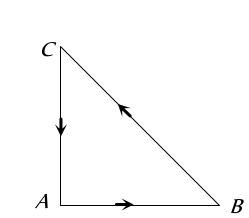
Three forces starts acting simultaneously on a particle moving with velocity $\vec{v}$. These forces are represented in magnitude and direction by the three sides of a triangle $A B C$ (as shown). The particle will now move with velocity
Image
  • $\vec{v}$ remaining unchanged
  • B
    Less than $\vec{v}$
  • C
    Greater than $\vec{v}$
  • D
    $\vec{v}$ in the direction of the largest force $B C$

Answer

Correct option: A.
$\vec{v}$ remaining unchanged
(a) Net force on the particle is zero so the $v$ remains unchanged.

Need a full question paper?

Generate a complete, print-ready paper with questions like this in minutes — across 16+ boards, with answer keys.

Start Generating Free

Similar questions

Peltier coefficient for the junction of a pair of metals is proportional to 
Which of the following graph depicts spring constant $k$ versus length $l$ of the spring correctly
A $100$ watt bulb working on $200$ volt and a $200$ watt bulb working on $100$ volt have
The angular velocity of the earth with which it has to rotate so that acceleration due to gravity on $60$ latitude becomes zero is (Radius of earth $=6400 \mathrm{~km}$. At the poles $g=10 \mathrm{~ms}^{-2}$ )
A prism $(\mu=1.5)$ has the refracting angle of $30^{\circ}$. The deviation of a monochromatic ray incident normally on its one surface will be $\left(\sin 48^{\circ} 36^{\prime}=0.75\right)$
If $1\ A$ of current is passed through $CuSO _4$ solution for $10$ seconds, then the number of copper ions deposited at the cathode will be about
A man is watching two trains, one leaving and the other coming in with equal speeds of $4 \mathrm{~m} / \mathrm{sec}$. If they sound their whistles, each of frequency $240 \mathrm{~Hz}$, the number of beats heard by the man (velocity of sound in air $=320 \mathrm{~m} / \mathrm{sec}$ ) will be equal to
A laser beam is used for carrying out surgery because it
The relation between the linear magnification $m$, the object distance $u$ and the focal length $f$ is
We have two (narrow) capillary tubes $T$ and $T$. Their lengths are $l$ and $I$ and radii of cross-section are $r$ and $r$ respectively. The rate of flow of water under a pressure difference $P$ through tube $T$ is $8 cm / sec$. If $I=2 l$ and $r=r$, what will be the rate of flow when the two tubes are connected in series and pressure difference across the combination is same as before $(=P)$