MCQ 11 Mark
When the speed of a moving body is doubled
- A
Its acceleration is doubled
- B
Its kinetic energy is doubled
- C
Its potential energy is doubled
- ✓
View full question & answer→MCQ 21 Mark
If in a stationary lift, a man is standing with a bucket full of water, having a hole at its bottom. The rate of flow of water through this hole is $0$ . If the lift starts to move up and down with same acceleration and then that rates of flow of water are and , then
- ✓
$ Q_1 > Q_0 > Q_2$
- B
$ Q_2 > Q_0 > Q_1$
- C
$ Q_2 > Q_1 > Q_0$
- D
AnswerCorrect option: A. $ Q_1 > Q_0 > Q_2$
$ Q_1 > Q_0 > Q_2$
View full question & answer→MCQ 31 Mark
A pulley fixed to the ceilling carries a string with blocks of mass $m$ and $3 m$ attached to its ends. The masses of string and pulley are negligible. When the system is released, its centre of mass moves with what acceleration
- A
$g/5$
- ✓
$g / 4$
- C
$g / 2$
- D
$-g / 2$
AnswerCorrect option: B. $g / 4$
$a_{c m}=\left(\frac{m_1-m_2}{m_1+m_2}\right)^2 g=\left(\frac{3\ mm}{3m+m} \right)^2 g=\frac{g}{4}$
View full question & answer→MCQ 41 Mark
A mass of $10 gm$ is suspended by a string and the entire system is falling with a uniform acceleration of $400 cm / sec ^2$. The tension in the string will be $\left(g=980 cm / sec ^2\right)$
- ✓
$5,800$ dyne
- B
$3,800$ dyne
- C
$11,800$ dyne
- D
$13,800$ dyne
AnswerCorrect option: A. $5,800$ dyne
(a) $T=m(g-a)=10(980-400)=5800$ dyne
View full question & answer→MCQ 51 Mark
Answer(d) Heavier gas will acquire largest momentum i.e. Argon.
View full question & answer→MCQ 61 Mark
A $2 kg$ block is lying on a smooth table which is connected by a body of mass $1 kg$ by a string which passes through a pulley. The 1 $kg$ mass is hanging vertically. The acceleration of block and tension in the string will be
- ✓
$3.27 m / s ^2, 6.54 N$
- B
$4.38 m / s ^2, 6.54 N$
- C
$3.27 m / s ^2, 9.86 N$
- D
$4.38 m / s ^2, 9.86 N$
AnswerCorrect option: A. $3.27 m / s ^2, 6.54 N$
Acceleration $=\frac{m_2}{m_1+m_2} \times g=\frac{1}{2+1}\times 9.8=3.27\mathrm{~m}\mathrm{s}^2$ and $T=m_1 a=2 \times 3.27=6.54\ N$
View full question & answer→MCQ 71 Mark
$n$ small balls each of mass $m$ impinge elastically each second on a surface with velocity $u$. The force experienced by the surface will be
- A
$m n u$
- ✓
$2\ mnu$
- C
$4 mnu$
- D
$\frac{1}{2} m n u$
AnswerCorrect option: B. $2\ mnu$
(b) $\vec{F}=\frac{d \vec{p}}{d t}=$ Rate of change of momentumAs balls collide elastically hence, rate of change of momentum of ball $=n[m u-(m u)]=2 m n u$ i.e. $F=2 m n и$
View full question & answer→MCQ 81 Mark
The average resisting force that must act on a $5 kg$ mass to reduce its speed from $65 cm / s$ to $15 cm / s$ in $0.2 s$ is
- ✓
$12.5 N$
- B
$25 N$
- C
$50 N$
- D
$100 N$
AnswerCorrect option: A. $12.5 N$
(a) $F=m\left(\frac{v-u}{t}\right)=\frac{5(65-15) \times 10^{-2}}{0.2}=12.5 \mathrm{~N}$
View full question & answer→MCQ 91 Mark
The resultant force of $5 N$ and $10 N$ can not be
- A
$12 N$
- B
$8 N$
- ✓
$4 N$
- D
$5 N$
Answer$F_{\max }=5+10=15 \mathrm{~N}$ and $F_{\min }=10-5=5 \mathrm{~N}$Rangeofresultant $5 \leq F \leq 15$
View full question & answer→MCQ 101 Mark
A rope of length $5 m$ is kept on frictionless surface and a force of $5 N$ is applied to one of its end. Find tension in the rope at $1 m$ from this end
- A
$1 N$
- B
$3 N$
- ✓
$4 N$
- D
$5 N$
Answer(c) $T=\frac{F(L-x)}{L}=\frac{5(5-1)}{5}=4 N$
View full question & answer→MCQ 111 Mark
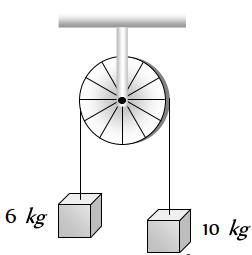
A light string passes over a frictionless pulley. To one of its ends a mass of $6 kg$ is attached. To its other end a mass of $10 kg$ is attached. The tension in the thread will be
- A
$24.5 N$
- B
$2.45 N$
- C
$79 N$
- ✓
$73.5 N$
AnswerCorrect option: D. $73.5 N$
(d) $T=\frac{2 m_1 m_2}{m_1+m_2} g=\frac{2 \times 10 \times 6}{10+6 \times9.8}=73.5 \mathrm N$
View full question & answer→MCQ 121 Mark
Three weights $W, 2 W$ and $3 W$ are connected to identical springs suspended from a rigid horizontal rod. The assembly of the rod and the weights fall freely. The positions of the weights from the rod are such that
- A
$3 W$ will be farthest
- B
$W$ will be farthest
- ✓
All will be at the same distance
- D
$2 W$ will be farthest
AnswerCorrect option: C. All will be at the same distance
(c) For $W, 2 W, 3 W$ apparent weight will be zero because the system is falling freely. So the distances of the weight from the rod will be same.
View full question & answer→MCQ 131 Mark
A man of weight $75 kg$ is standing in an elevator which is moving with an acceleration of $5 m / s ^2$ in upward direction the apparent weight of the man will be $\left(g=10 m / s ^2\right)$
- A
$1425 N$
- B
$1625 N$
- C
$1250 N$
- ✓
$1125 N$
AnswerCorrect option: D. $1125 N$
(d) The apparent weight,$R=m(g+a)=75(10+5)=1125 N$
View full question & answer→MCQ 141 Mark
A block of mass 5 is moving horizontally at a speed of $1.5 m / s$. A perpendicular force of $5 N$ acts on it for $4 sec$. What will be the distance of the block from the point where the force started acting
- ✓
$10 m$
- B
$8 m$
- C
$6 m$
- D
$2 m$
AnswerCorrect option: A. $10 m$
Assume initial velocity of $1.5 m / s$ is in the x -direction
Since there are no forces on it in this direction, there will be no acceleration.
So, distance $S _{ x }=1.5 \times 4=6 m$
In the y -direction, $F =5 N$ and $m =5 kg$
Acceleration in $y =$ direction,
$a _{ y }=\frac{ F }{ m }=\frac{5}{5}=1 m / s ^2 $
$S_{ y }=\frac{1}{2} a _{ y } t ^2=\frac{1}{2} \times 1 \times 4^2=8 m$
Resolving the x and y vector we get,
$S^2=S_{ x }^2+S_y^2 $
$S^2=6^2+8^2 $
$S=\sqrt{36+64} $
$S=\sqrt{100} $
$S=10\ m$
View full question & answer→MCQ 151 Mark
A rocket is ejecting $50$ of gases per sec at a speed of $500$. The accelerating force on the rocket will be
- A
$125\ N$
- ✓
$25\ N$
- C
$5\ N$
- D
AnswerCorrect option: B. $25\ N$
$F=u\left(\frac{d m}{d t}\right)=500 \times 50 \times 10^{-3}=25 \mathrm{~N}$
View full question & answer→MCQ 161 Mark
A body of mass $2 kg$ is moving with a velocity $8 m / s$ on a smooth surface. If it is to be brought to rest in 4 seconds, then the force to be applied is
Answer(b) $F=m a=\frac{m(u-v)}{t}=\frac{2 \times(8-0)}{4}=4 N$
View full question & answer→MCQ 171 Mark
An army vehicle of mass $1000 kg$ is moving with a velocity of $10 m / s$ and is acted upon by a forward force of $1000 N$ due to the engine and a retarding force of $500 N$ due to friction. What will be its velocity after $10 s$
- A
$5 m / s$
- B
$10 m / s$
- ✓
$15 m / s$
- D
$20 m / s$
AnswerCorrect option: C. $15 m / s$
(c) $v=u+\frac{F}{m} t=10+\left(\frac{1000-500}{1000}\right)\times10=15\mathrm{~m}/\mathrm{s}$
View full question & answer→MCQ 181 Mark
When a horse pulls a wagon, the force that causes the horse to move forward is the force
MCQ 191 Mark
A force of 100 dynes acts on a mass of $5 gram$ for $10 sec$. velocity produced is
AnswerCorrect option: B. $200\mathrm{~cm} / \mathrm{sec}$
(b) $v=u+a t=0+\left(\frac{F}{m}\right) t=\left(\frac{100}{5}\right)\times10=200\mathrm{~cm} / \mathrm{sec}$
View full question & answer→MCQ 201 Mark
A plumb line is suspended from a ceiling of a car moving with horizontal acceleration of $a$. What will be the angle of inclination with vertical
- ✓
$\tan ^{-1}(a/g)$
- B
$\sin ^{-1}(a/g)$
- C
$\cos ^{-1}(a/g)$
- D
$\cos ^{-1}(g/a)$
AnswerCorrect option: A. $\tan ^{-1}(a/g)$
View full question & answer→MCQ 211 Mark
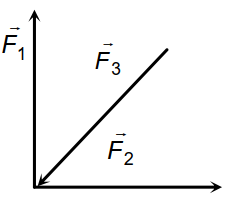
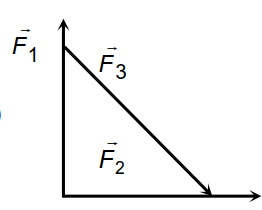
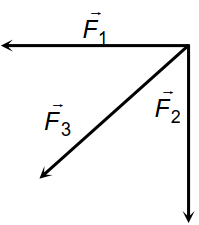
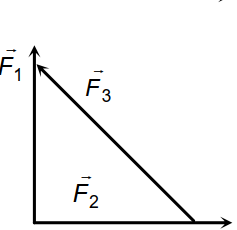
Which of the four arrangements in the figure correctly shows the vector addition of two forces $\overrightarrow{F_1}$ and $\overrightarrow{F_2}$ to yield the third force $\overrightarrow{F_3}$
View full question & answer→MCQ 221 Mark
A body of mass $8\ kg$ is moved by a force $F=3 x N$, where $x$ is the distance covered. Initial position is $x=2 m$ and the final position is $x=10 m$. The initial speed is $0.0 m / s$. The final speed is
- ✓
$6 m / s$
- B
$9 m / s$
- C
$18 m / s$
- D
$14 m / s$
AnswerCorrect option: A. $6 m / s$
Increment in kinetic energy = work done
$\Rightarrow \frac{1}{2m} \left(v^2-u^2\right)=\int_{x_1}^{x_2} F \cdot d x=\int_2^{10}(3 x) d x$
$ \Rightarrow \frac{1}{2}mv^2=\frac{3}{2}\left[x^2\right]_2^{10}=\frac{3}{2}[100-4]$
$\Rightarrow\frac{1}{2} \times 8 \times v^2=\frac{3}{2} \times 96 \Rightarrow v=6 \mathrm{~m} / \mathrm{s}$
View full question & answer→MCQ 231 Mark
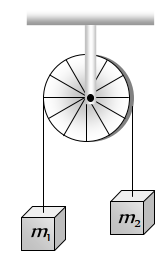
Two masses $m_1$ and $m_2$ are attached to a string which passes over a frictionless smooth pulley. When $m_1=10 kg$, $m_2=6 kg$, the acceleration of masses is
- A
$20 m / s ^2$
- B
$5 m / s^2$
- ✓
$2.5 m / s ^2$
- D
$10 m / s ^2$
AnswerCorrect option: C. $2.5 m / s ^2$
$a=\left(\frac{m_2-m_1}{m_1+m_2}\right) g=\left(\frac{10-6}{10+6}\right) \times10=2.5 \mathrm{~m} / \mathrm{s}^2$
View full question & answer→MCQ 241 Mark
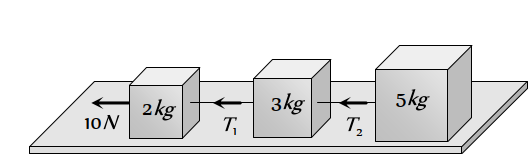
Three blocks of masses $2 kg , 3 kg$ and $5 kg$ are connected to each other with light string and are then placed on a frictionless surface as shown in the figure. The system is pulled by a force $F=10 N$, then tension $Q_1=$
- A
$1\ N$
- B
$5 \ N$
- ✓
$8\ N$
- D
$10\ N$
AnswerCorrect option: C. $8\ N$
(c) $\quad T_1=\left(\frac{m_2+m_3}{m_1+m_2+m_3}\right)g=\frac{3+5}{2+3+5\times10}=8\mathrm{~N}$
View full question & answer→MCQ 251 Mark
A bullet mass $10\ gm$ is fired from a gun of mass $1 \ kg$. If the recoil velocity is $5 \ m / s$, the velocity of the muzzle is
- A
$0.05\ m / s$
- B
$5\ m / s$
- C
$50 \ m / s$
- ✓
$500\ m / s$
AnswerCorrect option: D. $500\ m / s$
$m_G v_G=m_B v_B$
$ \Rightarrow v_B=\frac{m_G v_G}{m_B}=\frac{1 \times 5}{10\times10^{-3}}=500 \mathrm{~m} / \mathrm{s}$
View full question & answer→MCQ 261 Mark
A body is imparted motion from rest to move in a straight line. If it is then obstructed by an opposite force, then
- A
The body may necessarily change direction
- ✓
Opposite force causes retardation.
- C
The body will necessarily continue to move in the same direction at the same speed
- D
AnswerCorrect option: B. Opposite force causes retardation.
(b) Opposite force causes retardation.
View full question & answer→MCQ 271 Mark
A diwali rocket is ejecting $0.05 kg$ of gases per second at a velocity of $400 m / sec$. The accelerating force on the rocket is
- A
$20$ dynes
- ✓
$20 \mathrm{~N}$
- C
$22$ dynes
- D
$1000\ N$
AnswerCorrect option: B. $20 \mathrm{~N}$
(b) $F=u\left(\frac{d m}{d t}\right)=400 \times 0.05=20 \mathrm{~N}$
View full question & answer→MCQ 281 Mark
A body of mass $40\ gm$ is moving with a constant velocity of $2\ cm / sec$ on a horizontal frictionless table. The force on the table is
- ✓
$39200$ dyne
- B
$300$ dyne
- C
$80$ dyne
- D
AnswerCorrect option: A. $39200$ dyne
Force on the table $=m g=40 \times 980=39200$ dyne
View full question & answer→MCQ 291 Mark
When a body is stationary
- A
There is no force acting on it
- B
The force acting on it is not in contact with it
- ✓
The combination of forces acting on it balances each other
- D
AnswerCorrect option: C. The combination of forces acting on it balances each other
View full question & answer→MCQ 301 Mark
A rocket has a mass of $100 kg$. $90 \%$ of this is fuel. It ejects fuel vapours at the rate of $1 kg / sec$ with a velocity of $500 m / sec$ relative to the rocket. It is supposed that the rocket is outside the gravitational field. The initial upthrust on the rocket when it just starts moving upwards is
- A
- ✓
$500 N$
- C
$1000 N$
- D
$2000 N$
AnswerCorrect option: B. $500 N$
(b) $F=u\left(\frac{d m}{d t}\right)=500 \times 1=500 \mathrm{~N}$
View full question & answer→MCQ 311 Mark
In the above problem, if the lift moves up with a constant velocity of $2\ m / sec$, the reading on the balance will be
AnswerCorrect option: A. $2 \mathrm{~kg}$
The lift is not accelerated, hence the reading of the balance will be equal to the true weight.$R=m g=2 g \text { Newton or } 2 \mathrm{~kg}$
View full question & answer→MCQ 321 Mark
A body of mass $2 kg$ moving on a horizontal surface with an initial velocity of $4 m / sec$ comes to rest after $2 sec$. If one wants to keep this body moving on the same surface with a velocity of $4 m / sec$, the force required is
AnswerCorrect option: B. $4\ N$
$u=4 \mathrm{~m} / \mathrm{s}, v=0, t=2 \mathrm{sec}/v$
$=u+at\Rightarrow 0=4+2 a \Rightarrow a=-2 \mathrm{~m} / \mathrm{s}^2 $
$\therefore \text { Retarding force }=m a=2 \times 2=4 \mathrm{~N}$
This force opposes the motion. If the same amount of force is applied in forward direction, then the body will move with constant velocity.
View full question & answer→MCQ 331 Mark
The weight of an aeroplane flying in the air is balanced by
- A
Vertical component of the thrust created by air currents striking the lower surface of the wings
- B
Force due to reaction of gases ejected by the revolving propeller
- C
Upthrust of the air which will be equal to the weight of the air having the same volume as the plane
- ✓
Force due to the pressure difference between the upper and lower surfaces of the wings created by different air speeds on the surfaces
AnswerCorrect option: D. Force due to the pressure difference between the upper and lower surfaces of the wings created by different air speeds on the surfaces
(d) Application of Bernoulli's theorem.
View full question & answer→MCQ 341 Mark
if the tension in the cable of $1000 kg$ elevator is $1000 kg$ weight, the levator
- A
- B
Its potential energy is doubled
- C
May be at rest or accelerating
- ✓
May be at rest or in uniform motion
AnswerCorrect option: D. May be at rest or in uniform motion
Since $T=m g$, it implies that elevator may be at rest or in uniform motion.
View full question & answer→MCQ 351 Mark
A jet plane flies in the air because
- A
The gravity does not act on bodies moving with high speeds
- ✓
The thrust of the jet compensates for the force of gravity
- C
The flow of air around the wings causes an upward force, which compensates for the force of gravity
- D
The weight of air whose volume is equal to the volume of the plane is more than the weight of the plane
AnswerCorrect option: B. The thrust of the jet compensates for the force of gravity
View full question & answer→MCQ 361 Mark
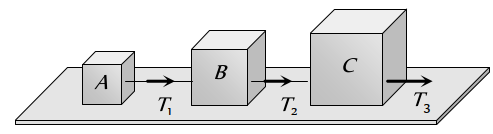
Three blocks $A, B$ and $C$ weighing 1,8 and $27 kg$ respectively are connected as shown in the figure with an inextensible string and are moving on a smooth surface. $T_3$ is equal to $36 N$. Then $T_2$ is
- A
$20 N$
- B
$40 N$
- C
$10 N$
- ✓
$32 N$
AnswerCorrect option: D. $32 N$
(d)
$T_2=(m_1\ + M_2)\times \frac{T_3}{m_1+m_2+m_3}=\frac{10+6 \times 40}{20}=32\ N$
View full question & answer→MCQ 371 Mark
If a bullet of mass $5 gm$ moving with velocity $100 m / sec$, penetrates the wooden block upto $6 cm$. Then the average force imposed by the bullet on the block is
- A
$8300 N$
- ✓
$833.33 N$
- C
$830 N$
- D
AnswerCorrect option: B. $833.33 N$
$F = ma$
$a =\frac{ v }{ t } \text { and } t =\frac{ x }{ v }$
Mass in kg,
$a=\frac{v^2}{x}=\frac{100^2}{6 \times 10^{-2}}$
$F=\frac{5}{1000} \times \frac{100^2}{6 \times 10^{-2}}=833.33 N$
View full question & answer→MCQ 381 Mark
The mass of a lift is $500 kg$. When it ascends with an acceleration of $2 m / s ^2$, the tension in the cable will be $\left[g=10 m / s ^2\right]$
- ✓
$6000\ N$
- B
$500\ N$
- C
$4000\ N$
- D
$50 \ N$
AnswerCorrect option: A. $6000\ N$
(a) $T=m(g+a)=500(10+2)=6000 \mathrm{~N}$
View full question & answer→MCQ 391 Mark
A bird is sitting in a large closed cage which is placed on a spring balance. It records a weight of $25 N$. The bird (mass $m =0.5 kg$ ) flies upward in the cage with an acceleration of $2 m / s ^2$. The spring balance will now record a weight of
- A
$24 N$
- ✓
$25 N$
- C
$26 N$
- D
$27 N$
AnswerCorrect option: B. $25 N$
Since the cage is closed and we can treat bird, cage and the air as a closed (isolated) system. In this condition the force applied by the bird on cage is an internal force, due to this the reading of spring balance will not change.
View full question & answer→MCQ 401 Mark
A ball of mass $400\ gm$ is dropped from a height of $5\ m$. A boy on the ground hits the ball vertically upwards with a bat with an average force of $100$ newton so that it attains a vertical height of $20\ m$. The time for which the ball remains in contact with the bat is $\left[g=10 m / s ^2\right]$
- ✓
$0.12\ s$
- B
$0.4\ s$
- C
$0.04\ s$
- D
$12\ s$
AnswerCorrect option: A. $0.12\ s$
$M =0.4 kg $
$h _1=5 m $
$h _2=20 m $
$g=10 m / s ^2 $
$\text { velocity of ball after dropping } 5 m: u $
$\text { velocity of ball after being hit by bat: } v $
$u^2=2 g h_1 $
$\therefore u =\sqrt{2 \times 10 \times 5} $
$u =10 m / s \text { downwards } $
$v ^2=2 gh _2 $
$\therefore v =\sqrt{2 \times 10 \times 20} $
$=20 m / s \text { upwards } $
$\text { Change in momentum }=\text { impulse }= m ( v + u ) $
$=0.4(10+20) $
$=0.4 \times 30 $
$=12 kg m / s $
$\text { Force }=100 N=12 / t $
$t =\text { time of contact }=0.12\ sec \text {. }$
View full question & answer→MCQ 411 Mark
Two forces with equal magnitudes $F$ act on a body and the magnitude of the resultant force is $F / 3$. The angle between the two forces is
- ✓
$\cos ^{-1}\left(-\frac{17}{18}\right)$
- B
$\cos ^{-1}\left(-\frac{1}{3}\right)$
- C
$\cos ^{-1}\left(\frac{2}{3}\right)$
- D
$\cos ^{-1}\left(\frac{8}{9}\right)$
AnswerCorrect option: A. $\cos ^{-1}\left(-\frac{17}{18}\right)$
(a)$F_{n e t}^2=F_1^2+F_2^2+2 F_1F_2 \cos \theta \Rightarrow \left(\frac{F}{3}\right)^2$
$=F^2+F^2+2 F^2\cos\theta\Rightarrow \cos \theta=\left(\frac{17}{18}\right)$
View full question & answer→MCQ 421 Mark
Newton's first law of motion describes the following
Answer(c) Newton's first law of motion defines the inertia of body. It states that every body has a tendency to remain in its state (either rest or motion) due to its inerta.
View full question & answer→MCQ 431 Mark
A boy having a mass equal to 40 kilograms is standing in an elevator. The force felt by the feet of the boy will be greatest when the elevator $\left(g=9.8\right.$ metres $\left./ sec ^2\right)$
AnswerCorrect option: D. Accelerates upward with an acceleration equal to 4 metres / $sec ^2$
View full question & answer→MCQ 441 Mark
10,000 small balls, each weighing $1\ gm$, strike one square $cm$ of area per second with a velocity $100\ m / s$ in a normal direction and rebound with the same velocity. The value of pressure on the surface will be
- A
$2 \times 10^3 N / m ^2$
- B
$3 \times 10^7 N / m ^2$
- C
$6 \times 10^7 N / m ^2$
- ✓
$2 \times 10^7 N / m ^2$
AnswerCorrect option: D. $2 \times 10^7 N / m ^2$
$P=\frac{F}{A}=\frac{n[m v-(-m v)]}{A}=\frac{2 m n v}{A}$
$=\frac{2\times 10^{-3} \times 10^4 \times 10^2}{10^{-4}}=2 \times 10^7 \mathrm{~N} / \mathrm{m^2}$
View full question & answer→MCQ 451 Mark
A man is standing on a weighing machine placed in a lift. When stationary his weight is recorded as $40 kg$. If the lift is accelerated upwards with an acceleration of $2 m / s ^2$, then the weight recorded in the machine will be $\left(g=10 m / s ^2\right)$
- A
$32\ kg$
- B
$22\ kg$
- C
$42\ kg$
- ✓
$48\ kg$
AnswerCorrect option: D. $48\ kg$
In stationary lift man weighs $40 \mathrm{~kg}$i.e$400\mathrm{~N}$.Whenliftaccelerates upward it's apparent weight $=m(g+a)=40(10+2)=480 \mathrm{~N}$ i.e. $48 \mathrm{~kg}$
For the clarity of concepts in this problem $k g$ - wt can be used in place of $\mathrm{kg}$.
View full question & answer→MCQ 461 Mark
In a rocket of mass $1000 kg$ fuel is consumed at a rate of $40 kg / s$. The velocity of the gases ejected from the rocket is $5 \times 10^4 m / s$. The thrust on the rocket is
- A
$2 \times 10^3 N$
- B
$2 \times 10^7 N$
- ✓
$2 \times 10^6 N$
- D
$2 \times 10^9 N$
AnswerCorrect option: C. $2 \times 10^6 N$
Thrust $F=u\left(\frac{d m}{d t}\right)=5 \times 10^4 \times 40=2 \times10^6\mathrm{~N}$
View full question & answer→MCQ 471 Mark
A wagon weighing $1000 kg$ is moving with a velocity $50 km / h$ on smooth horizontal rails. A mass of $250 kg$ is dropped into it. The velocity with which it moves now is
- A
$2.5 km / hour$
- B
$20 km / hour$
- ✓
$40 km / hour$
- D
$50 km / hour$
AnswerCorrect option: C. $40 km / hour$
(c) According to principleofconservationoflinearmomentum $1000\times50=1250\times v\Rightarrow v=40 \mathrm{~km} / \mathrm{hr}$
View full question & answer→MCQ 481 Mark
The linear momentum $p$ of a body moving in one dimension varies with time according to the equation $p=a+b t^2$, where $a$ and $b$ are positive constants. The net force acting on the body is
AnswerCorrect option: C. Proportional to $t$
$\vec{F}=\frac{d \vec{p}}{d t}=\frac{d}{d t}\left(a+b t^2\right)=2 b t$ i.e $(F \propto t )$
View full question & answer→MCQ 491 Mark
When a train stops suddenly, passengers in the running train feel an instant jerk in the forward direction because
- A
The back of seat suddenly pushes the passengers forward
- B
Inertia of rest stops the train and takes the body forward
- ✓
Upper part of the body continues to be in the state of motion whereas the lower part of the body in contact with seat remains at rest
- D
Nothing can be said due to insufficient data
AnswerCorrect option: C. Upper part of the body continues to be in the state of motion whereas the lower part of the body in contact with seat remains at rest
View full question & answer→MCQ 501 Mark
A rider on horse back falls when horse starts running all of a sudden because
- A
- B
Rider is suddenly afraid of falling
- ✓
Inertia of rest keeps the upper part of body at rest whereas lower part of the body moves forward with the horse
- D
AnswerCorrect option: C. Inertia of rest keeps the upper part of body at rest whereas lower part of the body moves forward with the horse
View full question & answer→