MCQ
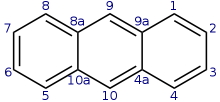
Three fused benzene rings are found in
  • A
    Naphthalene
  • Anthracene
  • C
    Phenanthroline
  • D
    Triphenyl methane

Answer

Correct option: B.
Anthracene
b
Anthracene is a solid polycyclic aromatic hydrocarbon ($PAH$) of formula $C _{14} H _{10}$ consisting of three fused benzene rings. It is a component of coal tar. 

Anthracene is used in the production of the red dye alizarin and other dyes.

Anthracene is colorless but exhibits a blue $(400-500\, nm$ peak) fluorescence under ultraviolet radiation
Need a full question paper?

Generate a complete, print-ready paper with questions like this in minutes — across 16+ boards, with answer keys.

Start Generating Free

Similar questions

The metal that has very low melting point and its periodic position is closer to a metalloid is.
A mixture of methyl alcohol and acetone can be separated by
While estimating the nitrogen present in an organic compound by Kjeldahl's method, the ammonia evolved from $0.25\,g$ of the compound neutralized $2.5\,mL$ of $2\,M\,H _{2} SO _{4}$. The percentage of nitrogen present in organic compound is $......$
Which of the following is the Fischer projection of $L-$ threonine (also known as  $(2S, 3R) \, 2-$ amino $-3-$ hydroxybutanoic acid) ?
Which of the following is/are produced when a mixture of benzene vapour and oxygen is passed over $V_2O_5$ catalyst at $775\, K$ ?
The reagent in Friedel Craft's reaction is
Which of the among is strongest base ?
For $2\ moles$ of $He$ (ideal gas), find the work done in a process where it is heated from $200\ K$ to $400\ K$ such that the enthalpy of  the gas varies as : $H = 10\ V^2$
$3.00\, moles$ of $PCl_5$ kept in $1\,L$ closed reaction vessel was allowed to attain  equilibrium at $380\, K$. If $1.59 \, mole$ reactant was converted into the product at  equilibrium. Then $K_c$ :-
Match the List$-I$ with List$-II$ :
Cations Group reaction
$P \rightarrow Pb ^{2+}, Cu ^{2+}$ $(i)$ $H _2 S$ gas in presence of dilute $HCl$
$Q \rightarrow Al ^{3+}, Fe ^{3+}$ $(ii)$ $\left( NH _4\right)_2 CO _3$ in presence of $NH _4 OH$
$R \rightarrow Co ^{2+}, Ni ^{2+}$ $(iii)$ $NH _4 OH$ in presence of $NH _4 CI$
$S \rightarrow Ba ^{2+}, Ca ^{2+}$ $(iv)$ $H _2 S$ in presence of $NH _4 OH$