MCQ
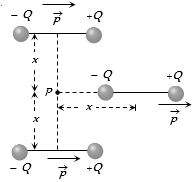
Three identical dipoles are arranged as shown below. What will be the net electric field at $P$ $\left( {k = \frac{1}{{4\pi {\varepsilon _0}}}} \right)$
  • A
    $\frac{{k.p}}{{{x^3}}}$
  • B
    $\frac{{2kp}}{{{x^3}}}$
  • Zero
  • D
    $\frac{{\sqrt 2 \,kp}}{{{x^3}}}$

Answer

Correct option: C.
Zero
c
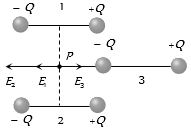
(c) Point $P$ lies at equatorial positions of dipole $1$ and $2$ and axial position of dipole $3$.
Hence field at $P$
due to dipole $1$
${E_1} = \frac{{k.p}}{{{x^3}}}$ (towards left)
due to dipole $2$
${E_2} = \frac{{k.p}}{{{x^2}}}$ (towards left)
due to dipole $3$ ${E_3} = \frac{{k.(2p)}}{{{x^3}}}$ (towards right)
So net field at $P$ will be zero.

Need a full question paper?

Generate a complete, print-ready paper with questions like this in minutes — across 16+ boards, with answer keys.

Start Generating Free

Similar questions

A Young's double slit experiment uses a monochromatic source. The shape of the  interference fringes formed on a screen is
Two uniformly charged spherical conductors $A$ and $B$ of radii $5 mm$ and $10 mm$ are separated by a distance of $2 cm$. If the spheres are connected by a conducting wire, then in equilibrium condition, the ratio of the magnitudes of the electric fields at the surface of the sphere $A$ and $B$ will be .
To find the focal length of a convex mirror, a student records the following data

Object Pin Convex Lens Convex Mirror Image Pin
  $22.2\,cm$   $32.2\,cm$   $45.8\,cm$   $71.2\,cm$

The focal length of the convex lens is $f_1$  and that of mirror is $f_2$. Then taking index correction to be negligibly small, $f_1$  and  $f_2$ are close to

An ideal coil of $10\, henry$ is joined in series with a resistance of $5 \,ohm$ and a battery of $5 \,volt$. $2$ second after joining, the current flowing in ampere in the circuit will be
'Electrons revolve round the nucleus in well$-$defined orbits, like planets revolve round the sun' was the brainchild of:
A circular ring carries a uniformly distributed positive charge. The electric field $(E) $ and potential $ (V) $ varies with distance $(r)$ from the centre of the ring along its axis as
The resistance of a discharge tube is
Ohmic
Two polaroids have their polarizing directions parallel so that the intensity of a transmitted light is maximum. The angle through which either polaroid must be turned if the intensity is to drop by one-half is.....$^o$
The adjoining figure shows a negatively charged electroscope. If a negatively charged rod is brought close to, but not touching, the knob, the two leaves will:
Three point charges of magnitude $5 \mu C , 0.16 \mu C$ and $0.3 \mu C$ are located at the vertices $A , B , C$ of a right angled triangle whose sides are $AB =3\,cm$, $BC =3 \sqrt{2}\,cm$ and $CA =3\,cm$ and point $A$ is the right angle corner. Charge at point $A$ experiences

$N$ of electrostatic force due to the other two charges.