Question
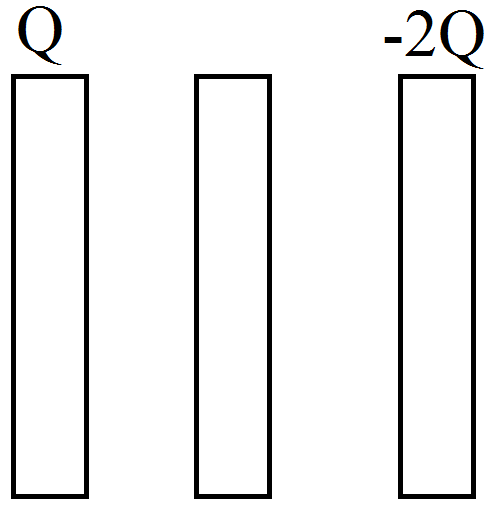
Three identical metal plates with large surface areas are kept parallel to each other as shown in figure. The leftmost plate is given a charge Q, the rightmost a charge -2Q and the middle one remains neutral. Find the charge appearing on the outer surface of the rightmost plate.
Answer


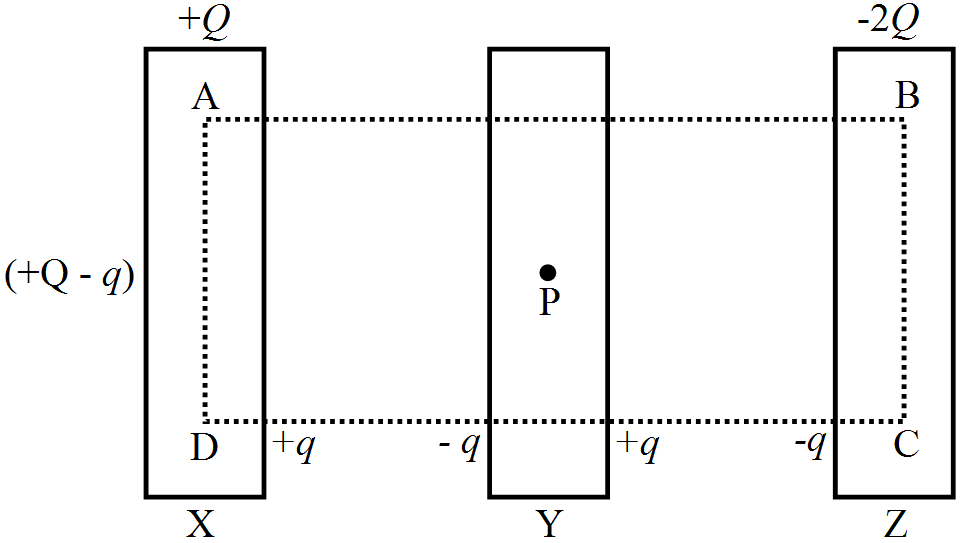
Consider the Gaussian surface as shown in the figure.
Let the charge on the outer surface of the left-most plate be q. Thus, the charges on the plates are distributed as shown in the diagram.
The net field at point P due to all the induced charges must be zero, as it is lying inside the metal surface.
Let the surface area of the plates be A.
Electric field at point P due to the charges on plate X:
Due to charge (+Q - q) is $\frac{\text{Q}-\text{q}}{2\text{A}\epsilon_0}$ in the right direction
Due to charge (+q) is $\frac{\text{q}}{2\text{A}\epsilon_0}$ in the right direction
Electric field at point P due to charges on plate Y:
Due to charge (-q) is $\frac{\text{q}}{2\text{A}\epsilon_0}$ in the right direction
Due to charge (+q) is $\frac{\text{q}}{2\text{A}\epsilon_0}$ in the left direction
Electric field at point P due to charges on plate Z:
Due to charge (-q) is $\frac{\text{q}}{2\text{A}\epsilon_0}$ in the right direction
Due to charge (-2Q + q) is $\frac{\text{2Q}-\text{q}}{2\text{A}\epsilon_0}$ in the right direction
The net electric field at point P:
$\frac{\text{Q}-\text{q}}{2\text{a}\epsilon_0}+\frac{\text{q}}{2\text{A}\epsilon_0}-\frac{\text{q}}{2\text{A}\epsilon_0}-\frac{\text{q}}{2\text{A}\epsilon_0}+\frac{\text{q}}{2\text{A}\epsilon_0}+\frac{\text{2Q}-\text{q}}{2\text{A}\epsilon_0}=0$
$\frac{\text{Q}-\text{q}}{2\text{A}\epsilon_0}+\frac{\text{2Q}-\text{q}}{2\text{A}\epsilon_0}=0$
$\text{Q}-\text{q}+\text{2Q}-\text{q}=0$
$\text{3Q}-2\text{q}=0$
$\text{q}=\frac{\text{3Q}}{2}$
Thus, the charge on the outer plate of the right-most plate
$-2\text{Q}+\text{q}=-2\text{Q}+\frac{3\text{Q}}{2}=-\frac{\text{Q}}{2}$

Need a full question paper?

Generate a complete, print-ready paper with questions like this in minutes — across 16+ boards, with answer keys.

Start Generating Free

Similar questions

A 0’5 m long metal rod PQ completes the circuit as shown in the figure. The area of the circuit is perpendicular to the magnetic field of flux density 0-15 T. If the resistance of the total circuit is 3Ω, calcularod in the direction as indicated with a constant speed ofte the force needed to move the rod in the direction as indicated with a constant speed of 2ms−1.
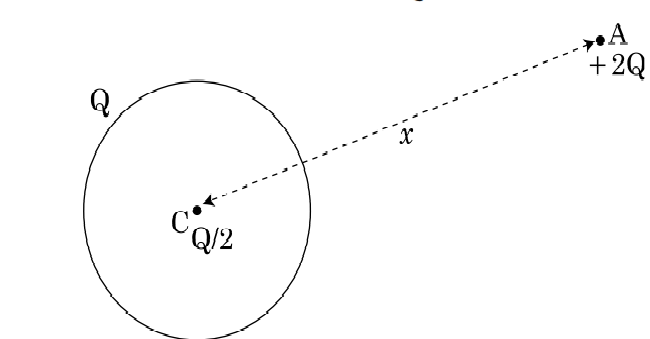
A thin metallic spherical shell of radius $R$ carries a charge $Q$ on its surface. $A$ point charge $Q/2$ is placed at the centre $C,$ and another charge $+ 2Q$ is placed outside the shell at $A$ at a distance $x$ from the centre as shown in the figure.
  1. Find the electric flux through the shell.
  2. State the law used.
  3. Find the force on the charges at the centre $C$ of the shell and at the point $A.$
Consider the situation of the previous problem. Find the average electric field energy stored in the capacitor and the average magnetic field energy stored in the coil.
Half life of $^{238}\text{U}_{92}$against$\alpha$ decay is $4.5 \times 10^{9}$years. Calculate the activity of Ig sample of$^{238}\text{U}_{92}$? Given Avogadro's number $= 6 \times 10^{26}$atoms/kmol.
  1. In the following diagram ‘S’ is a semiconductor. Would you increase or decrease the value of R to keep the reading of the ammeter A constant when S is heated? Give reason for your answer.
  1. Draw the circuit diagram of a photodiode and explain its working. Draw its I - V characteristics.
Find the radius and energy of a $He^+$ ion in the states $(a) n = 1, \ (b) n = 4$ and $(c) n = 10.$
A uniform tube closed at one end, contains a pellet of mercury $10\ cm$ long. When the tube is kept vertically with the closed$-$end upward, the length of the air column trapped is $20\ cm$. Find the length of the air column trapped when the tube is inverted so that the closedend goes down. Atmospheric pressure $= 75\ cm$ of mercury.
Draw a circuit diagram of a transistor amplifier in CE configuration. Under what condition does the transistor act as an amplifier?
Define the terms:
i. Input resistance and
ii. Current amplification factor. How are these determined using typical input and output characteristics?
A candle flame 1.6cm high is imaged in a ball bearing of diameter 0.4cm. If the ball bearing is 20cm away from the flame, find the location and the height of the image.
A concave mirror has a focal length of $20\ cm$. Find the position or positions of an object for which the imagesize is double of the object$-$size.