Question
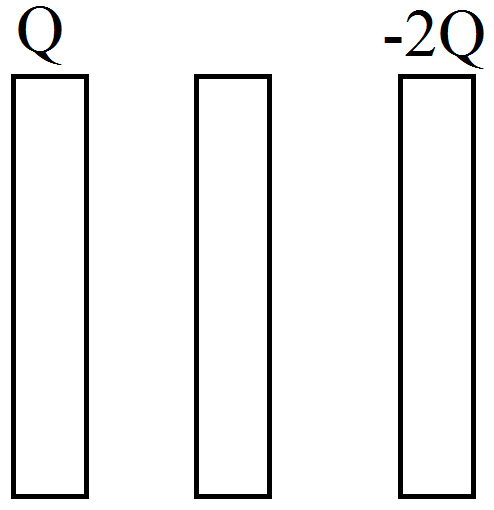
Three identical metal plates with large surface areas are kept parallel to each other as shown in figure. The leftmost plate is given a charge Q, the rightmost a charge -2Q and the middle one remains neutral. Find the charge appearing on the outer surface of the rightmost plate.
Answer


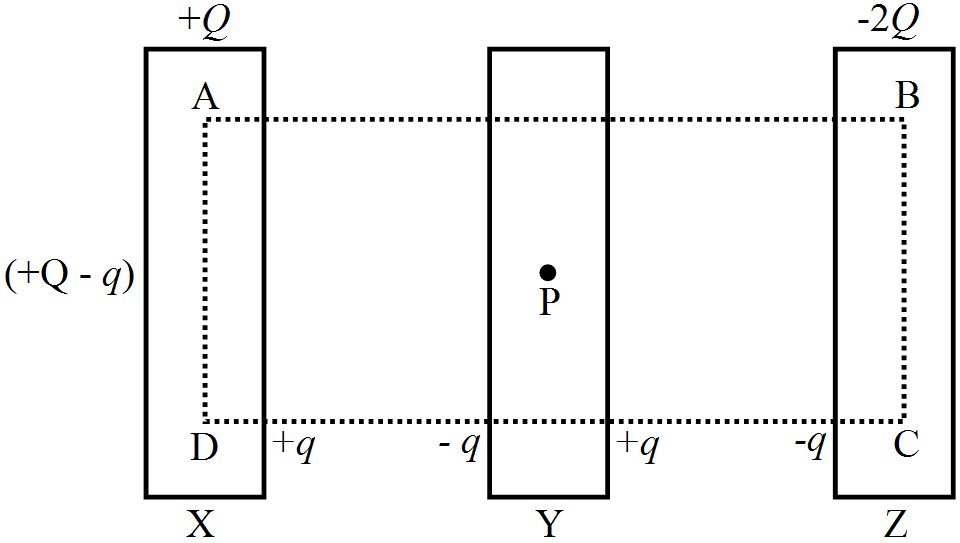
Consider the Gaussian surface as shown in the figure.
Let the charge on the outer surface of the left-most plate be q. Thus, the charges on the plates are distributed as shown in the diagram.
The net field at point P due to all the induced charges must be zero, as it is lying inside the metal surface.
Let the surface area of the plates be A.
Electric field at point P due to the charges on plate X:
Due to charge (+Q - q) is $\frac{\text{Q}-\text{q}}{2\text{A}\epsilon_0}$ in the right direction
Due to charge (+q) is $\frac{\text{q}}{2\text{A}\epsilon_0}$ in the right direction
Electric field at point P due to charges on plate Y:
Due to charge (-q) is $\frac{\text{q}}{2\text{A}\epsilon_0}$ in the right direction
Due to charge (+q) is $\frac{\text{q}}{2\text{A}\epsilon_0}$ in the left direction
Electric field at point P due to charges on plate Z:
Due to charge (-q) is $\frac{\text{q}}{2\text{A}\epsilon_0}$ in the right direction
Due to charge (-2Q + q) is $\frac{\text{2Q}-\text{q}}{2\text{A}\epsilon_0}$ in the right direction
The net electric field at point P:
$\frac{\text{Q}-\text{q}}{2\text{a}\epsilon_0}+\frac{\text{q}}{2\text{A}\epsilon_0}-\frac{\text{q}}{2\text{A}\epsilon_0}-\frac{\text{q}}{2\text{A}\epsilon_0}+\frac{\text{q}}{2\text{A}\epsilon_0}+\frac{\text{2Q}-\text{q}}{2\text{A}\epsilon_0}=0$
$\frac{\text{Q}-\text{q}}{2\text{A}\epsilon_0}+\frac{\text{2Q}-\text{q}}{2\text{A}\epsilon_0}=0$
$\text{Q}-\text{q}+\text{2Q}-\text{q}=0$
$\text{3Q}-2\text{q}=0$
$\text{q}=\frac{\text{3Q}}{2}$
Thus, the charge on the outer plate of the right-most plate
$-2\text{Q}+\text{q}=-2\text{Q}+\frac{3\text{Q}}{2}=-\frac{\text{Q}}{2}$

Need a full question paper?

Generate a complete, print-ready paper with questions like this in minutes — across 16+ boards, with answer keys.

Start Generating Free

Similar questions

Explain how the groups of different energy levels can be made in -semi-conductors like Si and Ge crystals with band diagram
A gas cylinder has walls that can bear a maximum pressure of $1.0 \times 10^6Pa.$ It contains a gas at $8.0 \times 10^5Pa$ and $300K.$ The cylinder is steadily heated. Neglecting any change in the volume, calculate the temperature at which the cylinder will break.
Let $\overrightarrow{\text{A}}$ and $\overrightarrow{\text{B}}$ be the two vectors of magnitude 10 unit each. If they are inclined to the X-axis at angles 30° and 60° respectively, find the resultant.
  1. Describe the working principle of a solar cell. Mention three basic processes involved in the generation of emf.
  2. Why are Si and GaAs preferred materials for solar cells?
Two moving coil meters, $M_1$ and $M_2$ have the following particulars:
$R_1 = 10 \Omega, N_1 = 30,$
$A_1 = 3.6 \times 10^{–3} m^2, B_1 = 0.25 T$
$R_2 = 14 \Omega, N_2 = 42,$
$A_2 = 1.8 \times 10^{–3} m^2, B_2 = 0.50 T$
$($The spring constants are identical for the two meters$).$
Determine the ratio of $(a)$ current sensitivity and $(b)$ voltage sensitivity of $M_2$ and $M_1.$
A wheel of moment of inertia $0.500\ kg-m^2$ and radius $20.0\ cm$ is rotating about its axis at an angular speed of $20.0\ rad/s.$ It picks up a stationary particle of mass $200g$ at its edge. Find the new angular speed of the wheel.
A long, straight wire carrying a current of $1.0A$ is placed horizontally in a uniform magnetic field $B = 1.0 \times 10^{-5}T$ pointing vertically upward figure. Find the magnitude of the resultant magnetic field at the points $P$ and $Q,$ both situated at a distance of $2.0\ cm$ from the wire in the same horizontal plane.
A wheel of mass 10kg and radius 20cm is rotating at an angular speed of 100rev/min when the motor is turned off. Neglecting the friction at the axle, calculate the force that must be applied tangentially to the wheel to bring it to rest in 10 revolutions.
What is space wave propagation? State the factors which limit its range of propagation. Derive an expression for the maximum line of sight distance between two antennas for space wave propagation.
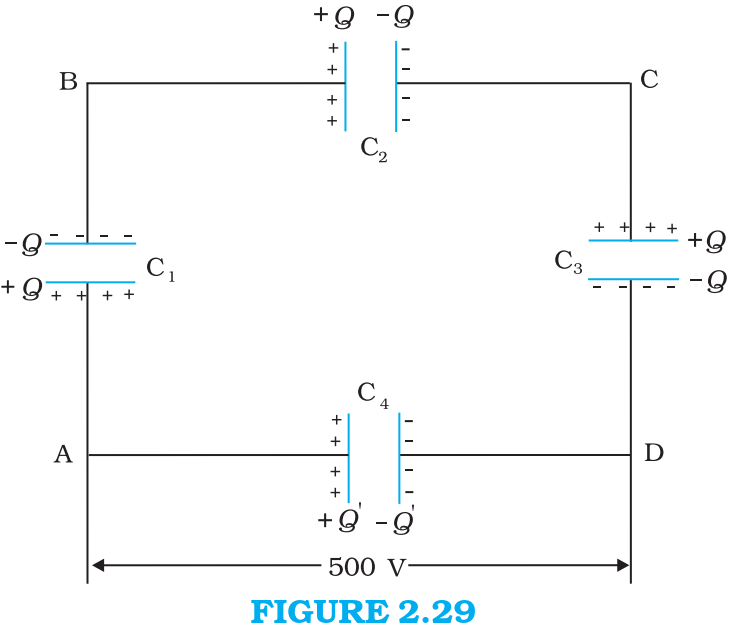
A network of four $10 \mu F$ capacitors is connected to a $500 V$ supply, as shown in Fig. $2.29$. Determine $(a)$ the equivalent capacitance of the network and $(b)$ the charge on each capacitor. $($Note, the charge on a capacitor is the charge on the plate with higher potential, equal and opposite to the charge on the plate with lower potential.$)$
Image