Questions

3 Marks Question

Take a timed test

9 questions · self-marked practice — reveal the answer and mark yourself.

Question 13 Marks
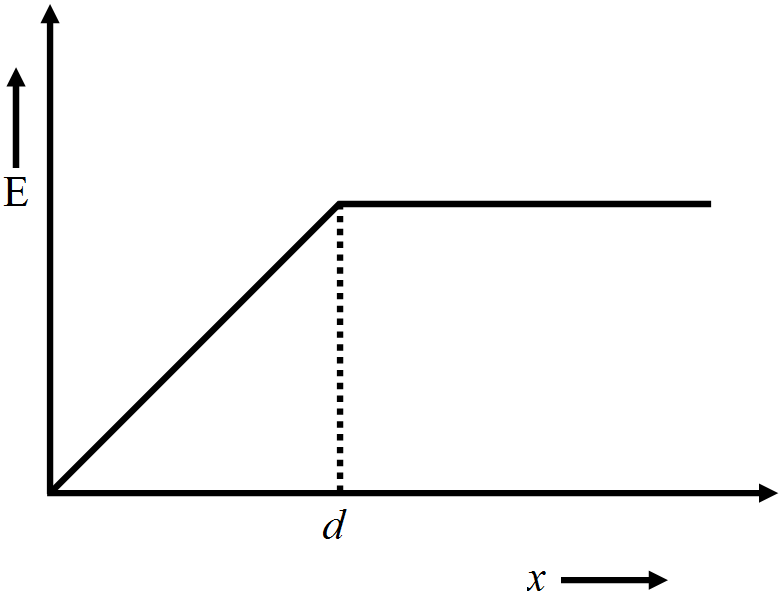
A nonconducting sheet of large surface area and thickness d contains uniform charge distribution of density $\rho.$ Find the electric field at a point P inside the plate, at a distance x from the central plane. Draw a qualitative graph of E against x for 0 < x < d.
Answer
Given: Thickness of the sheet = d Let the surface area of the sheet be s. Volume of the sheet = sd Volume charge density of the sheet, $\rho=\frac{\text{Q}}{\text{sd}}$ Charge on the sheet = Q
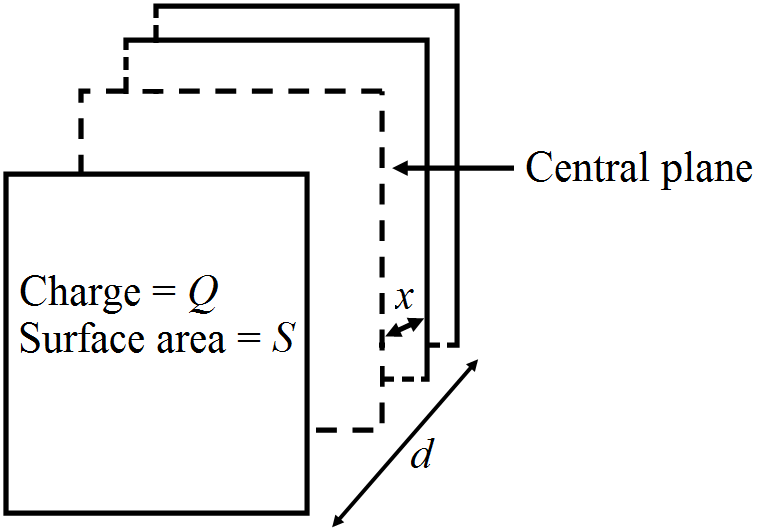
Consider an imaginary plane at a distance x from the central plane of surface area s. Charge enclosed by this sheet, $\text{q}=\rho\text{sx}$ For this Guassian surface, using Gauss's Law,we get: $\oint\text{E.ds}=\frac{\text{q}}{\epsilon_0}$ $\text{E}.\text{s}=\frac{\rho\text{sx}}{\epsilon_0}$ $\text{E}=\frac{\rho\text{x}}{\epsilon_0}$ The electric field outside the sheet will be constant and will be: $\text{E}=\frac{\rho\text{d}}{\epsilon_0}$
View full question & answer
Question 23 Marks
A spherical volume contains a uniformly distributed charge of density $2.0 \times 10^{-4}Cm^{-3}.$ Find the electric field at a point inside the volume at a distance $4.0\ cm$ from the centre.
Answer
Given :
Volume charge density, $\rho=2\times10^{-4}\text{C/m}^3$
Let us assume a concentric spherical surface inside the given sphere with radius $= 4\ cm = 4 \times 10^{-2}m$
The charge enclosed in the spherical surface assumed can be found by multiplying the volume charge density with the volume of the sphere. Thus,
$\text{q}=\rho\times\frac{4}3{}\pi\text{r}^3$
$\Rightarrow\text{q}=\big(2\times10^{-4}\big)\times\frac{4}{3}\pi\text{r}^3$
The net flux through the spherical surface,
$\phi=\frac{\text{q}}{\epsilon_0}$
The surface area of the spherical surface of radius $r\ cm:$
$\text{A}=4\pi\text{r}^2$
Electric field,
$\text{E}=\frac{\text{q}}{\epsilon_0\times\text{A}}$
$\text{E}=\frac{2\times10^{-4}\times4\pi\text{r}^3}{\epsilon_0\times3\times4\pi\text{r}^2}$
$\text{E}=\frac{2\times10^{-4}\times\text{r}}{3\times\epsilon_0\times}$
The electric field at the point inside the volume at a distance $4.0\ cm$ from the centre,
$\text{E}=\frac{(2\times10^{-4})\times(4\times10^{-2})}{3\times(8.85\times10^{-12})}\text{N/C}$
$\text{E}=3.0\times10^{5}\text{N/C}$
View full question & answer
Question 33 Marks
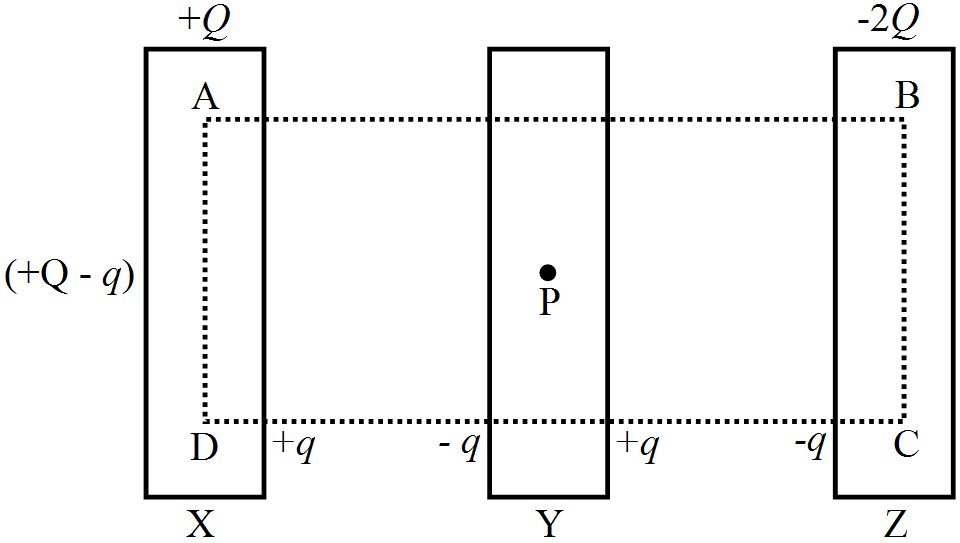
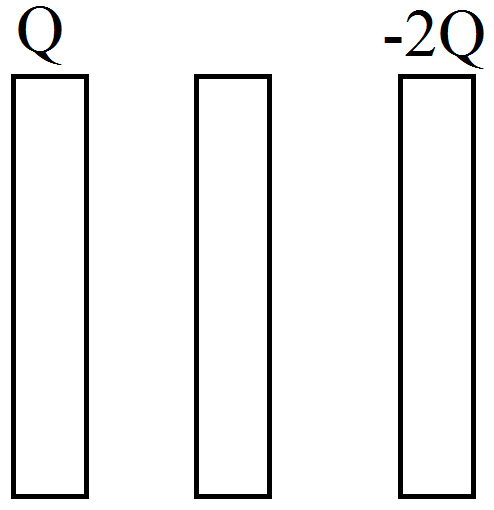
Three identical metal plates with large surface areas are kept parallel to each other as shown in figure. The leftmost plate is given a charge Q, the rightmost a charge -2Q and the middle one remains neutral. Find the charge appearing on the outer surface of the rightmost plate.
Answer

Consider the Gaussian surface as shown in the figure.
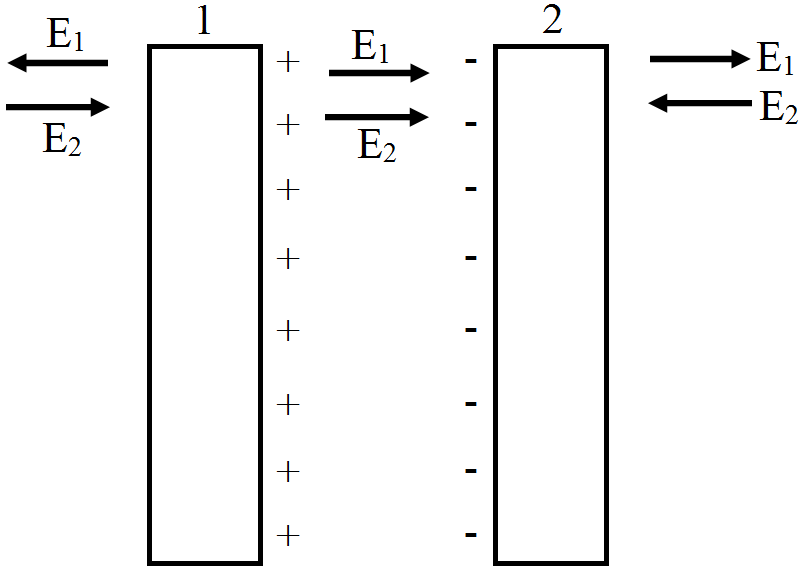
Let the charge on the outer surface of the left-most plate be q. Thus, the charges on the plates are distributed as shown in the diagram.
The net field at point P due to all the induced charges must be zero, as it is lying inside the metal surface.
Let the surface area of the plates be A.
Electric field at point P due to the charges on plate X:
Due to charge (+Q - q) is $\frac{\text{Q}-\text{q}}{2\text{A}\epsilon_0}$ in the right direction
Due to charge (+q) is $\frac{\text{q}}{2\text{A}\epsilon_0}$ in the right direction
Electric field at point P due to charges on plate Y:
Due to charge (-q) is $\frac{\text{q}}{2\text{A}\epsilon_0}$ in the right direction
Due to charge (+q) is $\frac{\text{q}}{2\text{A}\epsilon_0}$ in the left direction
Electric field at point P due to charges on plate Z:
Due to charge (-q) is $\frac{\text{q}}{2\text{A}\epsilon_0}$ in the right direction
Due to charge (-2Q + q) is $\frac{\text{2Q}-\text{q}}{2\text{A}\epsilon_0}$ in the right direction
The net electric field at point P:
$\frac{\text{Q}-\text{q}}{2\text{a}\epsilon_0}+\frac{\text{q}}{2\text{A}\epsilon_0}-\frac{\text{q}}{2\text{A}\epsilon_0}-\frac{\text{q}}{2\text{A}\epsilon_0}+\frac{\text{q}}{2\text{A}\epsilon_0}+\frac{\text{2Q}-\text{q}}{2\text{A}\epsilon_0}=0$
$\frac{\text{Q}-\text{q}}{2\text{A}\epsilon_0}+\frac{\text{2Q}-\text{q}}{2\text{A}\epsilon_0}=0$
$\text{Q}-\text{q}+\text{2Q}-\text{q}=0$
$\text{3Q}-2\text{q}=0$
$\text{q}=\frac{\text{3Q}}{2}$
Thus, the charge on the outer plate of the right-most plate
$-2\text{Q}+\text{q}=-2\text{Q}+\frac{3\text{Q}}{2}=-\frac{\text{Q}}{2}$
View full question & answer
Question 43 Marks
A charge $Q$ is uniformly distributed over a rod of length $l.$ Consider a hypothetical cube of edge $l$ with the centre of the cube at one end of the rod. Find the minimum possible flux of the electric field through the entire surface of the cube.
Answer
Given:
Total charge on the rod $= Q$
The length of the rod $=$ edge of the hypothetical cube $= l$
Portion of the rod lying inside the cube, $\text{x}=\frac{\text{l}}2{}$
Linear charge density for the rod $=\frac{\text{Q}}{\text{l}}$ 
Using Gauss's theorem, flux through the hypothetical cube,
$\phi=\Big(\frac{\text{Q}_{\text{in}}}{\epsilon_0}\Big),$ where $Q_{in}=$ charge enclosed inside the cube
Here, charge per unit length of the rod $=\frac{\text{Q}}{\text{l}}$
Charge enclosed, $\text{Q}_{\text{in}}=\frac{\text{Q}}{\text{l}}\times\frac{\text{l}}{2}=\frac{\text{Q}}{2}$
Therefore,
$\phi=\frac{\frac{\text{Q}}{2}}{\epsilon_0}=\frac{\text{Q}}{2\epsilon_0}$
View full question & answer
Question 53 Marks
A charged particle having a charge of $-2.0 \times 10^{-6}C$ is placed close to a nonconducting plate having a surface charge density $4.0 \times 10^{-5}Cm^{-2}.$ Find the force of attraction between the particle and the plate.
Answer
The electric field due to a conducting thin sheet, $\text{E}=\frac{\sigma}{2\epsilon_0}$ The magnitude of attractive force between the particle and the plate, $\text{F}=\text{qE}$
$\text{F}=\frac{\text{q}\times\sigma}{2\epsilon_0}$
$\text{F}=\frac{\big(2.0\times10^{-6}\big)\times\big(4.0\times10^{-6}\big)}{2\times\big(8.85\times10^{-12}\big)}$
$\text{F}=0.45\text{N}$
View full question & answer
Question 63 Marks
A circular ring of radius $r$ made of a nonconducting material is placed with its axis parallel to a uniform electric field. The ring is rotated about a diameter through $180^\circ$ . Does the flux of electric field change? If yes, does it decrease or increase?
Answer
It is given that the circular ring, made of a non-conducting material, of radius r is placed with its axis parallel to a uniform electric field.This means that both the electric field and the area vector are parallel to each other $($area vector is always perpendicular to the surface area$)$. Thus, the flux through the ring is given by $\vec{\text{E}}.\vec{\text{S}}={\text{ES}}\cos0=\text{E}(\pi\text{r}^2).$
Now, when the ring is rotated about its diameter through $180^\circ$ , the angle between the area vector and the electric field becomes $180^\circ$ . Thus, the flux becomes $-\text{E}(\pi\text{r}^2).$
View full question & answer
Question 73 Marks
The electric field in a region is given by $\overrightarrow{\text{E}}=\frac{3}{5}\text{E}_0\overrightarrow{\text{i}}+\frac{4}{5}\text{E}_0\overrightarrow{\text{j}}$ with $\text{E}_0=2.0\times10^3\text{NC}^{-1}.$ Find the flux of this field through a rectangular surface of area $0.2m^2$ parallel to the $y-z$ plane.
Answer
Given:
Electric field strength, $\overrightarrow{\text{E}}=\frac{3}{5}\text{E}_0\hat{\text{i}}+\frac{4}{5}\text{E}_0\hat{\text{j}}$
where $\text{E}_0=2.0\times10^3\text{N/C}$
The plane of the rectangular surface is parallel to the $y-z$ plane. The normal to the plane of the rectangular surface is along the $x$ axis.
Only $\frac{3}{5}\text{E}_0\hat{\text{i}}$ passes perpendicular to the plane; so, only this component of the field will contribute to flux.
On the other hand, $\frac{4}{5}\text{E}_0\hat{\text{i}}$ moves parallel to the surface.
Surface area of the rectangular surface, $a = 0.2m^2$​​​​​​​
Flux,
$\phi=\overrightarrow{\text{E}}.\overrightarrow{\text{a}}=\text{E}\times\text{a}$
$\phi=\Big(\frac{3}5{}\times2\times10^3\Big)\times(2\times10^{-1})\text{Nm}^2/\text{C}$
$\phi=0.24\times10^3\text{Nm}^2/\text{C}$
$\phi=240\text{Nm}^2/\text{C}$
View full question & answer
Question 83 Marks
A spherical shell made of plastic, contains a charge Q distributed uniformly over its surface. What is the electric field inside the shell? If the shell is hammered to deshape it without altering the charge, will the field inside be changed? What happens if the shell is made of a metal?
Answer
As the shell is made of plastic, it is non-conducting. But as the charge is distributed uniformly over the surface of the shell, the sum of all the electric field vectors at the centre due to this kind of distribution is zero. But when the plastic shell is deformed, the distribution of charge on it becomes non-uniform. In other words, the sum of all the electric field vectors is non-zero now or the electric field exists at the centre now.
In case of a deformed conductor, the field inside is always zero.
View full question & answer
Question 93 Marks
It is said that any charge given to a conductor comes to its surface. Should all the protons come to the surface? Should all the electrons come to the surface? Should all the free electrons come to the surface?
Answer
Protons never take part in any electrical phenomena because they are inside the nuclei and are not able to interact easily. These are the free electrons that are responsible for all electrical phenomena. So, if a conductor is given a negative charge, the free electrons come to the surface of the conductor. If the conductor is given a positive charge, electrons move away from the surface and leave a positive charge on the surface of the conductor.
View full question & answer