Question
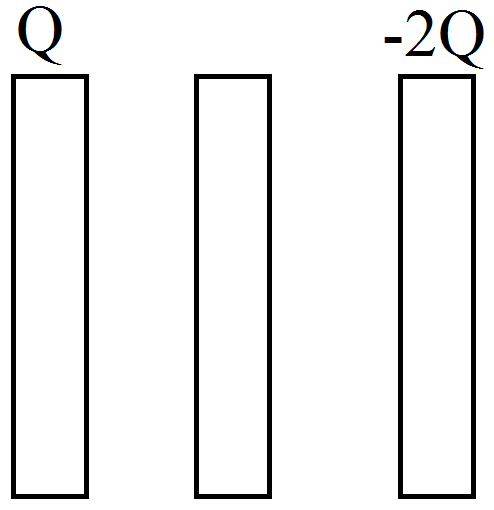
Three identical metal plates with large surface areas are kept parallel to each other as shown in figure. The leftmost plate is given a charge Q, the rightmost a charge -2Q and the middle one remains neutral. Find the charge appearing on the outer surface of the rightmost plate.

Answer


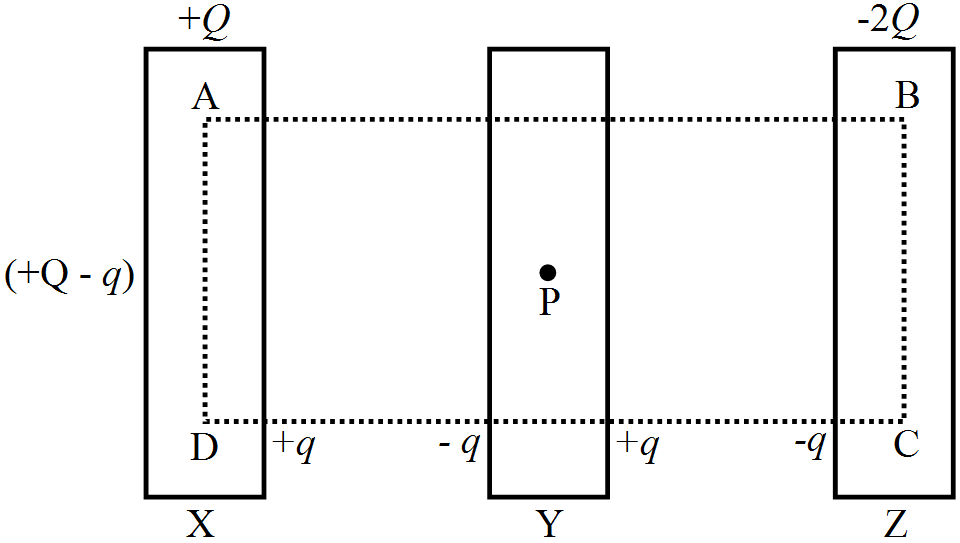
Consider the Gaussian surface as shown in the figure.

Let the charge on the outer surface of the left-most plate be q. Thus, the charges on the plates are distributed as shown in the diagram.

The net field at point P due to all the induced charges must be zero, as it is lying inside the metal surface.

Let the surface area of the plates be A.

Electric field at point P due to the charges on plate X:

Due to charge (+Q - q) is $\frac{\text{Q}-\text{q}}{2\text{A}\in_0}$ in the right direction

Due to charge (+q) is $\frac{\text{q}}{2\text{A}\in_0}$ in the right direction

Electric field at point P due to charges on plate Y:

Due to charge (-q) is $\frac{\text{q}}{2\text{A}\in_0}$ in the right direction

Due to charge (+q) is $\frac{\text{q}}{2\text{A}\in_0}$ in the left direction

Electric field at point P due to charges on plate Z:

Due to charge (-q) is $\frac{\text{q}}{2\text{A}\in_0}$ in the right direction

Due to charge (-2Q + q) is $\frac{\text{2Q}-\text{q}}{2\text{A}\in_0}$ in the right direction

The net electric field at point P:

$\frac{\text{Q}-\text{q}}{2\text{a}\in_0}+\frac{\text{q}}{2\text{A}\in_0}-\frac{\text{q}}{2\text{A}\in_0}-\frac{\text{q}}{2\text{A}\in_0}+\frac{\text{q}}{2\text{A}\in_0}+\frac{\text{2Q}-\text{q}}{2\text{A}\in_0}=0$

$\frac{\text{Q}-\text{q}}{2\text{A}\in_0}+\frac{\text{2Q}-\text{q}}{2\text{A}\in_0}=0$

$\text{Q}-\text{q}+\text{2Q}-\text{q}=0$

$\text{3Q}-2\text{q}=0$

$\text{q}=\frac{\text{3Q}}{2}$

Thus, the charge on the outer plate of the right-most plate

$-2\text{Q}+\text{q}=-2\text{Q}+\frac{3\text{Q}}{2}=-\frac{\text{Q}}{2}$
Need a full question paper?

Generate a complete, print-ready paper with questions like this in minutes — across 16+ boards, with answer keys.

Start Generating Free

Similar questions

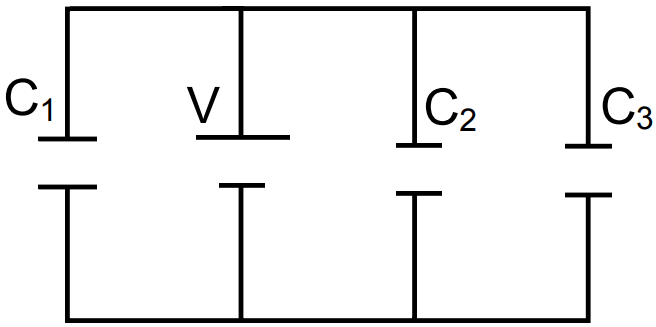
Find the charges on the three capacitors connected to a battery as shown in figure. Take $\text{C}_1=2.0\mu\text{F},\ \text{C}_2=4.0\mu\text{F},\ \text{C}_3=6.0\mu\text{F}$ and V = 12 volts.

To increase the current sensitivity of a moving coil galvanometer by 50%, its resistance is increased so that the new resistance becomes twice its initial resistance. By what factor does its voltage sensitivity change?
Calculate the amount of energy released during the $\alpha - $ decay of $^{238}_{92}\text{U}\to ^{234}_{92}\text{Th} + ^{4} _{2}\text{He}$

Given:

  1. Atomic mass of $^{238}_{92}\text{U}= 238.05079u$
  2. Atomic mass of  $^{234}_{90}\text{Th}= 234.04363u$

  3. Atomic mass of $^{4}_{2}\text{He}= 4.00260\text{ u}$

$\text{1u} = 931.5 \text{MeV/c}^{2}$

Is this decay spontaneous? Give reason.

A double convex lens, made from a material of refractive index $\mu_1,$ is immersed in a liquid of refractive index $\mu_2$ where $\mu_1>\mu_2.$ What change, if any, would occur in the nature of the lens?
How many time constants will elapse before the power delivered by a battery drops to half of its maximum value in an RC circuit?
Two long and parallel straight wires A and B carrying currents of 8.0 and 5.0 A in the same direction are separated by a distance of 4.0 cm. Estimate the force on a 10 cm section of wire A.
Consider the fusion in helium plasma. Find the temperature at which the average thermal energy 1.5kT equals the Coulomb potential energy at 2fm.
Calculate the energy released if U238-nucleus emits an $\alpha-$particle.

OR

Calculate the energy released in MeV in the following nuclear reaction.

$^{238}_{92}\text{U}\ \rightarrow\ ^{234}_{90}\text{Th}\ +\ ^4_2\text{He}\ +\ \text{Q}$

Given Atomic mass of 238U = 238.05079u

Atomic mass of 234Th = 234.04363u

Atomic mass of alpha particle = 4.00260u

1u = 931.5MeV/ c2

IS the decay spontaneous? Give reason.

A convex lens produces a double size real image when an object is placed at a distance of 18cm from it. Where should the object be placed to produce a triple size real image?
Two circular loops are placed coaxially but separated by a distance. A battery is suddenly connected to one of the loops establishing a current in it. Will there be a current induced in the other loop? If yes, when does the current start and when does it end? Do the loops attract each other or do they repel?