Three masses $700g, 500g$, and $400g$ are suspended at the end of a spring a shown and are in equilibrium. When the $700g$ mass is removed, the system oscillates with a period of $3$ seconds, when the $500 \,gm$ mass is also removed, it will oscillate with a period of ...... $s$
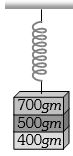
Medium


Download our appand get started for free
Experience the future of education. Simply download our apps or reach out to us for more information. Let's shape the future of learning together!No signup needed.*
Similar Questions
- 1Two particles executing $S.H.M.$ of same frequency, meet at $x=+A / 2$, while moving in opposite directions. Phase difference between the particles is .........View Solution
- 2View SolutionIf a hole is bored along the diameter of the earth and a stone is dropped into hole
- 3A pendulum is suspended in a lift and its period of oscillation when the lift is stationary is $T_0$. What must be the acceleration of the lift for the period of oscillation of the pendulum to be $T_0/2$ ?View Solution
- 4A block of mass $m$ attached to massless spring is performing oscillatory motion of amplitude $'A'$ on a frictionless horizontal plane. If half of the mass of the block breaks off when it is passing through its equilibrium point, the amplitude of oscillation for the remaining system become $fA.$ The value of $f$ isView Solution
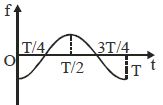
- 5A body is performing simple harmonic motion with amplitude a and time period $T$. Variation of its acceleration $(f)$ with time $(t)$ is shown in figure. If at time $t$, velocity of the body is $v$, which of the following graphs is correctView Solution
- 6A pendulum suspended from the ceiling of a train has a period $T$ when the train is at rest. When the train travels same distance per unit time, the period of oscillation isView Solution
- 7When a mass $M$ is attached to the spring of force constant $k$, then the spring stretches by $l$. If the mass oscillates with amplitude $l$, what will be maximum potential energy stored in the springView Solution
- 8The variation of kinetic energy $(KE)$ of a particle executing simple harmonic motion with the displacement $(x)$ starting from mean position to extreme position $(A)$ is given byView Solution
- 9A vertical mass spring system executes simple harmonic oscillations with a period of $2\,s$. A quantity of this system which exhibits simple harmonic variation with a period of $1\, sec$ isView Solution
- 10A particle of mass $m$ oscillates with simple harmonic motion between points ${x_1}$ and ${x_2}$, the equilibrium position being $O$. Its potential energy is plotted. It will be as given below in the graphView Solution