Question
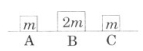
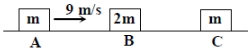
Three objects $A$, $B$ and $C$ are kept in a straight line on a frictionless horizontal surface. These have masses $m, 2 m$ and $m$, respectively. The object $A$ moves towards $B$ with a speed $9 \mathrm{~m} / \mathrm{s}$ and makes an elastic collision with it. Thereafter, $B$ makes completely inelastic collision with $C$. All motions occur on the same straight line. Find the final speed (in $\mathrm{m} / \mathrm{s}$ ) of the object $\mathrm{C}$.
Answer

After $1$ st collision

$mv _{ A }= mv _{ A }^{\prime}+2 mv _{ B }^{\prime}$

$-1=\frac{ v _{ B }^{\prime}- v _{ A }^{\prime}}{ o - v _{ A }} \Rightarrow v _{ B }^{\prime}=6 \ m / s$

After the and collision

$2 m v_{ B }^{\prime}=(2 \ m + m ) v _{ C } \Rightarrow v _{ C }=\frac{2}{3} v _{ B }^{\prime} \Rightarrow v _{ C }=4 \ m / s$

Need a full question paper?

Generate a complete, print-ready paper with questions like this in minutes — across 16+ boards, with answer keys.

Start Generating Free

Similar questions

A thin diamagnetic rod is placed vertically between the poles of an electromagnet. When the current in the electromagnet is switched on, then the diamagnetic rod is pushed up, out of the horizontal magnetic field. Hence the rod gains gravitational potential energy. The work required to do this comes from 
In a plane $EM$ wave, the electric field oscillates sinusoidally at a frequency of $5 \times 10^{10} \mathrm{~Hz}$ and an amplitude of $50 \mathrm{Vm}^{-1}$. The total average energy density of the electromagnetic field of the wave is :

[Use $\varepsilon_0=8.85 \times 10^{-12} \mathrm{C}^2 / \mathrm{Nm}^2$ ]

A certain piece of silver of given mass is to be made like a wire. Which of the following combination of length $(L)$ and the area of cross-sectional $(A) $ will lead to the smallest resistance
A rectangular loop has a sliding connector $PQ$ of length $l$ and resistance $R\ \Omega$ and it is moving with a speed $v$ as shown. The set-up is placed in a uniform magnetic field going into the plane of the paper. The three currents $I_1 , I_2$ and $I$ are
A ball of mass $200\,g$ rests on a vertical post of height $20\,m$. A bullet of mass $10\,g$, travelling in horizontal direction, hits the centre of the ball. After collision both travels independently. The ball hits the ground at a distance $30\,m$ and the bullet at a distance of $120\,m$ from the foot of the post. The value of initial velocity of the bullet will be $............m/s$ (if $\left.g =10 m / s ^2\right)$
A telescope of aperture $3 \times 10^{-2}\,m$ diameter is focused on a window at $80\, m$ distance fitted with a wire mesh of spacing $2\times10^{-3}\, m$. Given: $\lambda \, = 5.5\times10^{-7}\, m$ , which of the following is true for observing the mesh through the telescope?
The frequency of a sonometer wire is $100 Hz$. When the weights producing the tensions are completely immersed in water, the frequency becomes $80 Hz$ and on immersing the weights in a certain liquid, the frequency becomes $60 Hz$. The specific gravity of the liquid is 
Let $g$ be the acceleration due to gravity at earth's surface and $K$ be the rotational kinetic energy of the earth. Suppose the earth's radius decreases by $2\%$ keeping all other quantities same, then
A particle of mass $'\mathrm{m}'$ is projected with a velocity $v=\mathrm{kV}_{\mathrm{e}}(\mathrm{k}\,<\,1)$ from the surface of the earth.

$\left(\mathrm{V}_{\mathrm{e}}=\right.\text { escape velocity) }$

The maximum height above the surface reached by the particle is :

A body of mass $1\,kg$ is executing simple harmonic motion. Its displacement $y(cm)$ at $t$ seconds is given by $y = 6\sin (100t + \pi /4)$. Its maximum kinetic energy is ..... $J$