MCQ
Three particles $A, B$ and $C $projected from the same point with the same initial speeds making angle $30^\circ , 45^\circ$ and $60^\circ ,$ respectively with the horizontally. Which of the following statements is correct?
  • A
    $A, B$ and $C$ have unequal ranges.
  • Ranges of $A$ and $C$ are less than that of $B.$
  • C
    Ranges of $A$ and $C$ are equal and greater than that of $B.$
  • D
    $A, B$ and $C$ have equal ranges.

Answer

Correct option: B.
Ranges of $A$ and $C$ are less than that of $B.$
When a body is projected at an angle with the horizontal with initial velocity $u,$ then the horizontal range $R$ of projectile is $\text{R}=\frac{\text{u}^2\sin2\theta}{\text{g}}.$
Clearly, for maximum horizontal range $\sin2\theta=1$ or $2\theta=90^\circ$ or $\theta=45^\circ.$
Hence, in order to achieve maximum range, the body should be projected at $45^\circ .$
In this case $\text{R}_\text{max}=\frac{\text{u}^2}{\text{g}}$
Hence, ranges of $A$ and $C$ are less than that of $B.$

Need a full question paper?

Generate a complete, print-ready paper with questions like this in minutes — across 16+ boards, with answer keys.

Start Generating Free

Similar questions

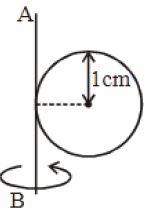
$5\,g$ and radius $1\,cm$ is fixed to a thin stick $AB$ of negligible mass as shown in the figure. The system is initially at rest. The constant torque, that will make the system rotate about $AB$ at $25$ rotations per second is $5\,s$ is close to
$x$ and  $y$ displacements of a particle are given as $x(t) = a\,sin\,\omega t$ and $y(t) = a\,sin\,2\omega t.$  Its trajectory will look like 
An isolated rail car of mass $M$ is moving along a straight, frictionless track at an initial speed $v_0$. The car is passing under a bridge when $a$ crate filled with $N$ bowling balls, each of mass $m$, is dropped from the bridge into the bed of the rail car. The crate splits open and the bowling balls bounce around inside the rail car, but none of them fall out. Is the momentum of the rail car $+$ bowling balls system conserved in this collision?
If the displacement of a particle varies with time as $\sqrt{x}=t+7$, then
Consider two cylindrical rods of identical dimensions, one of rubber and the other of steel. Both the rods are fixed rigidly at one end to the roof. $A$ mass $M$ is attached to each of the free ends at the centre of the rods.
A particle $P$ is moving in a circle of radius $'a'$ with a uniform speed $v$ . $C$ is the centre of the circle and $AB$ is a diameter. When passing through $B$ the angular velocity of $P$ about $A$ and $C$ are in the ratio 
If the measurement errors in all the independent quantities are known, then it is possible to determine the error in any dependent quantity. This is done by the use of series expansion and truncating the expansion at the first power of the error. For example, consider the relation $z=x / y$. If the errors in $x, y$ and $z$ are $\Delta x, \Delta y$ and $\Delta z$, respectively, then

$\mathrm{z} \pm \Delta \mathrm{z}=\frac{\mathrm{x} \pm \Delta \mathrm{x}}{\mathrm{y} \pm \Delta \mathrm{y}}=\frac{\mathrm{x}}{\mathrm{y}}\left(1 \pm \frac{\Delta \mathrm{x}}{\mathrm{x}}\right)\left(1 \pm \frac{\Delta \mathrm{y}}{\mathrm{y}}\right)^{-1} .$

The series expansion for $\left(1 \pm \frac{\Delta y}{y}\right)^{-1}$, to first power in $\Delta y / y$, is $1 \mp(\Delta y / y)$. The relative errors in independent variables are always added. So the error in $\mathrm{z}$ will be $\Delta \mathrm{z}=\mathrm{z}\left(\frac{\Delta \mathrm{x}}{\mathrm{x}}+\frac{\Delta \mathrm{y}}{\mathrm{y}}\right)$.

The above derivation makes the assumption that $\Delta x / x<<1, \Delta \mathrm{y} / \mathrm{y} \ll<1$. Therefore, the higher powers of these quantities are neglected.

($1$) Consider the ratio $\mathrm{r}=\frac{(1-\mathrm{a})}{(1+\mathrm{a})}$ to be determined by measuring a dimensionless quantity a.

If the error in the measurement of $\mathrm{a}$ is $\Delta \mathrm{a}(\Delta \mathrm{a} / \mathrm{a} \ll<1)$, then what is the error $\Delta \mathrm{r}$ in

$(A)$ $\frac{\Delta \mathrm{a}}{(1+\mathrm{a})^2}$ $(B)$ $\frac{2 \Delta \mathrm{a}}{(1+\mathrm{a})^2}$ $(C)$ $\frac{2 \Delta \mathrm{a}}{\left(1-\mathrm{a}^2\right)}$ $(D)$ $\frac{2 \mathrm{a} \Delta \mathrm{a}}{\left(1-\mathrm{a}^2\right)}$

($2$) In an experiment the initial number of radioactive nuclei is $3000$ . It is found that $1000 \pm$ $40$ nuclei decayed in the first $1.0 \mathrm{~s}$. For $|\mathrm{x}| \ll 1$, In $(1+\mathrm{x})=\mathrm{x}$ up to first power in $x$. The error $\Delta \lambda$, in the determination of the decay constant $\lambda$, in $\mathrm{s}^{-1}$, is

$(A) 0.04$    $(B) 0.03$    $(C) 0.02$   $(D) 0.01$

Give the answer quetion ($1$) and ($2$)
An object moving in a circular path at constant speed has constant
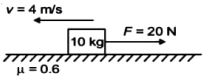
A block of mass $10 kg$ is moving on a rough surface as shown in figure. The frictional force acting on block is ...... $N$
The gravitational potential energy of a body of mass $‘m’$ at the earth’s surface $ - mg{R_e}$. Its gravitational potential energy at a height ${R_e}$ from the earth’s surface will be (Here ${R_e}$ is the radius of the earth)