MCQ
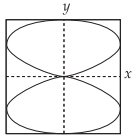
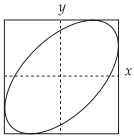
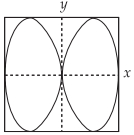
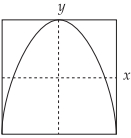
$x$ and  $y$ displacements of a particle are given as $x(t) = a\,sin\,\omega t$ and $y(t) = a\,sin\,2\omega t.$  Its trajectory will look like 
  • A

  • B


  • D

Answer

Correct option: C.

c
$\frac{x}{a}=\sin \omega t$

$\Rightarrow \cos \omega t=\sqrt{1-\left(\frac{x_{2}}{a^{2}}\right)}$

$\frac{y}{a}=\sin 2 \omega t$

$=2 \sin \omega t \times \cos \omega t$

$=2 \frac{x}{a} \times \sqrt{1-\left(\frac{x^{2}}{a^{2}}\right)}$

$ \Rightarrow y = \frac{{2x}}{{{a^2}}}\sqrt {\left( {a - x} \right)\left( {a + x} \right)} $

Hence trajectory of particle will look like as $(\mathrm{c})$

Need a full question paper?

Generate a complete, print-ready paper with questions like this in minutes — across 16+ boards, with answer keys.
Start Generating Free

Similar questions

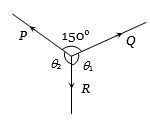
$P, Q$ and $R$ are three coplanar forces acting at a point and are in equilibrium. Given $P = 1.9318 \,kg \,wt$, $\sin {\theta _1} = 0.9659$, the value of $R$ is ( in kg wt)
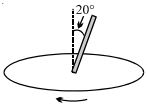
$A$ uniform rod is fixed to a rotating turntable so that its lower end is on the axis of the turntable and it makes an angle of $20^o$ to the vertical. (The rod is thus rotating with uniform angular velocity about a vertical axis passing through one end.) If the turntable is rotating clockwise as seen from above. What is the direction of the rod's angular momentum vector (calculated about its lower end)?
A spring balance is attached to the ceiling of a lift. $A$ man hangs his bag on the spring  and the spring reads $49 \,N$, when the lift is stationary. If the lift moves downward with  an acceleration of $5\, m/s^2$, the reading of the spring balance will be .......... $N$
When a ceiling fan is switched off, its angular velocity falls to half while it makes $36$ $rotations.$ How many more rotations will it make before coming to rest (Assume uniform angular retardation)
Two wires $A$ and $B$ of same length, same area of cross-section having the same Young's modulus are heated to the same range of temperature. If the coefficient of linear expansion of $A$ is $3/2$ times of that of wire $B$. The ratio of the forces produced in two wires will be
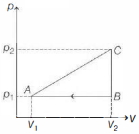
An ideal gas with constant heat capacity $C_V=\frac{3}{2} n R$ is made to carry out a cycle that is depicted by a triangle in the figure given below. The following statement is true about the cycle.
A piece of ice falls from a height $h$ so that it melts completely. Only one-quarter of the heat produced is absorbed by the ice and all energy of ice gets converted into heat during its fall. The value of $h$ is

[Latent heat of ice is $3.4 \times 10^{5}\; J / k g$ and $g=10\; N / kg ]$

The earth revolves about the sun in an elliptical orbit with mean radius $9.3 \times {10^7}\,m$ in a period of $1$ year. Assuming that there are no outside influences
A particle moving in a straight line covers half the distance with speed $6 \mathrm{~m} / \mathrm{s}$. The other half is covered in two equal time intervals with speeds 9 $\mathrm{m} / \mathrm{s}$ and $15 \mathrm{~m} / \mathrm{s}$ respectively. The average speed of the particle during the motion is :